← Back to Freestanding Gas Stoves & Sculptural Fireplaces
A Creative FireSpace™ · 24 August 2026
Element4 Ovation — The Old Shape, the New Standard
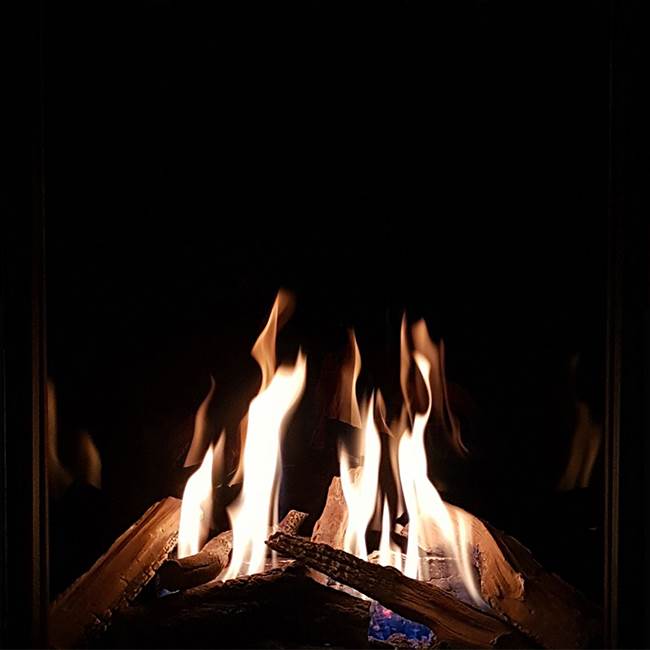
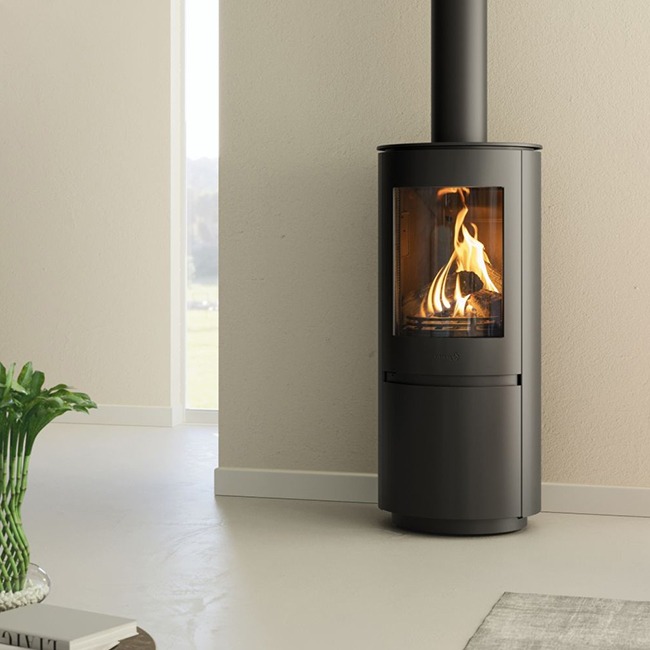
There is a shape all of us recognise without being told: a small stove standing on its own, a slim black pipe rising from its shoulder, a window of fire at its middle. It is the oldest domestic silhouette there is — and Element4, the award-winning Dutch house that spends most of its days building long, architectural, built-in fires, went back to it on purpose. Their own phrase for the brief was exactly right: the fireplace of the past, in a modern jacket.
What they put inside that jacket is why the Ovation is here. It runs Element4's award-winning Real Flame Burner — two burners arranged not as a row of jets under a log set, but so the flame rises from underneath and wraps itself around true-to-nature cleaved wood logs, the way fire actually behaves in a wood fire. Read it from across a room and the answer is unambiguous: that is wood, burning.
Then there is where it can go — which, for us, is usually the whole conversation.
A built-in fireplace asks something of the room first: a wall opened up, framing, a chase, drywall, finishing. The Ovation asks for almost nothing. It is freestanding. It stands on the floor, it vents straight up, and Element4's own note on it is that very little built-in installation work is required. That makes it one of the few genuinely beautiful fires you can bring into a room that was never built to have one — the corner of a condominium, an addition, a cabin, a converted attic, a room where the only honest answer used to be that there was nowhere for it to go.
And because it is a sealed, direct-vent appliance — a 4 × 6 inch coaxial flue that draws its combustion air from outside and sends everything back out the same way — the air in the room is never part of the transaction. No draught, no masonry chimney, no wood to carry in, no ash to carry out. Where a venting run is awkward, an optional Powerfan opens up routes that would otherwise be closed to it.
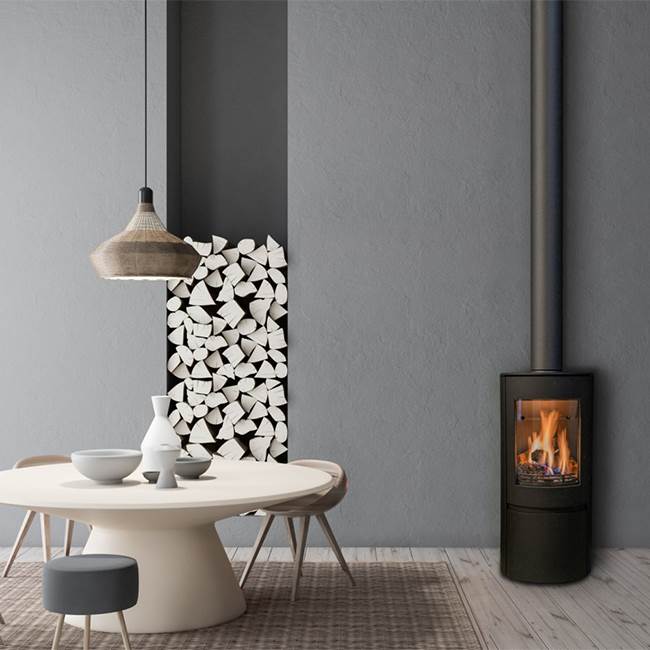
Most fires bought for the look of them are not really heaters, and most real heaters are not worth looking at. The Ovation is honestly both.
It is a sealed, direct-vent appliance putting roughly 22,500 BTU into a room on natural gas and 23,200 on propane — enough to hold a good-sized space on its own, without help. Element4 rates it 90% efficient, with an Energy Class A, on the European scale it is tested to. Canada measures fireplaces on a different scale altogether — the FE rating, from the Canadian CSA P.4.1 test — and the two numbers cannot honestly be set side by side. We would rather tell you that than let you compare the wrong ones, so ask us for the FE figure when you are weighing the Ovation against anything else on our floor. Very few people will volunteer it.
But the part we would actually point at is the bottom of that output range. The Ovation turns down to about 5,800 BTU — close to a four-to-one span, across six flame levels including a dedicated HI and LO — and it was engineered to still look right down there. That sounds like a small thing. In the homes we work in it is most of the year. The season that matters isn’t January; it's a cool, wet October evening in a room that is already comfortable, when what you want is the fire and not the warmth. A great many gas fires go thin and blue and apologetic the moment you turn them down. This one holds its shape.
It lights on electronic ignition with battery back-up, so it still works when the power doesn't — no small comfort in a November storm. A ten-button remote is standard; a WiFi kit (ProControl), home-automation control, or a plain wall switch are all options, so the fire can be as connected or as uncomplicated as you'd like it. Behind the ceramic glass, an Invisimesh safety screen comes standard — a barrier fine enough that you stop noticing it, which is the only kind worth having with children in the house. Black steel is the standard finish, with black reflective rear panels available if you want the flame doubled and given depth.
A note on placing one: freestanding does not mean unplanned. A stove still needs its clearances to combustibles honoured, a hearth pad where the floor calls for one, a gas line run to it, and a flue path taken cleanly up through ceiling and roof — and in a strata or a condominium, the building has a say of its own. Those are precisely the parts we work out first, on site and before anything is ordered: measuring, permitting, venting design, and the installation afterward by our own crew.
The fireplace of the past, in a modern jacket.
Questions people tend to ask
Does a wall have to be opened up to install it?
No, and that is most of the reason it is here. A built-in fireplace asks something of the room first — a wall opened up, framing, a chase, drywall, finishing. The Ovation is freestanding: it stands on the floor, it vents straight up, and Element4’s own note is that very little built-in work is required. It is one of the few genuinely beautiful fires you can bring into a room that was never built to have one.
Will it actually heat a room, or is it mostly for looking at?
Both, honestly. It is a sealed, direct-vent appliance putting roughly 22,500 BTU into a room on natural gas and 23,200 on propane — enough to hold a good-sized space on its own. Element4 rates it 90% efficient with an Energy Class A, but that is the European scale it is tested to; Canada measures fireplaces with the FE rating from the CSA P.4.1 test, and the two numbers cannot honestly be set side by side. Ask us for the FE figure when you are weighing it against anything else on our floor. Very few people will volunteer it.
Does it still look good turned down low?
This is the part we would actually point at. It turns down to about 5,800 BTU — close to a four-to-one span, across six flame levels including a dedicated HI and LO — and it was engineered to still look right down there. A great many gas fires go thin and blue and apologetic the moment you turn them down. This one holds its shape, which matters because a cool, wet October evening in an already-comfortable room is most of the year.
Will it work in a power cut?
Yes. It lights on electronic ignition with battery back-up, so it still works when the power doesn’t — no small comfort in a November storm.
Where can it go, and what does it need for venting?
It is sealed and direct-vent, on a 4 × 6 inch coaxial flue that draws combustion air from outside and sends everything back out the same way, so the air in the room is never part of the transaction — no draught, no masonry chimney, no wood to carry in, no ash to carry out. Where a venting run is awkward, an optional Powerfan opens up routes that would otherwise be closed to it. In practice that means the corner of a condominium, an addition, a cabin, a converted attic — rooms where the only honest answer used to be that there was nowhere for a fire to go.
Freestanding — so there is nothing to plan?
Freestanding does not mean unplanned. A stove still needs its clearances to combustibles honoured, a hearth pad where the floor calls for one, a gas line run to it, and a flue path taken cleanly up through ceiling and roof — and in a strata or a condominium the building has a say of its own. Those are the parts we work out first, on site and before anything is ordered.
How is it controlled?
A ten-button remote is standard. A WiFi kit (ProControl), home-automation control, or a plain wall switch are all options, so the fire can be as connected or as uncomplicated as you would like it.
Is it safe with children in the house?
Behind the ceramic glass an Invisimesh safety screen comes standard — a barrier fine enough that you stop noticing it, which is the only kind worth having. Black steel is the standard finish, with black reflective rear panels available if you want the flame doubled and given depth.