The fireplace that removed the louvres and let the flame stand alone — four traditional sizes, from a study to a great room.
The traditional gas fireplace has a problem it rarely admits to. It is trying to look like something it is not — a wood fire in an open masonry hearth — and for decades the give-away was never the flame. It was the frame: the louvred grille above the glass and the one below it, the vents and the trim that made a fire in a fine room look as though an appliance had been set into the wall.
Town & Country’s answer was the clean-face fireplace — glass to the edge, no louvres, the finish of the wall running right up to the opening — and it is not much of an exaggeration to say that every clean-faced gas fire sold today descends from it. Its fireplaces are designed and built in Duncan by Pacific Energy Fireplace Products, each one handcrafted and carrying a limited lifetime warranty.
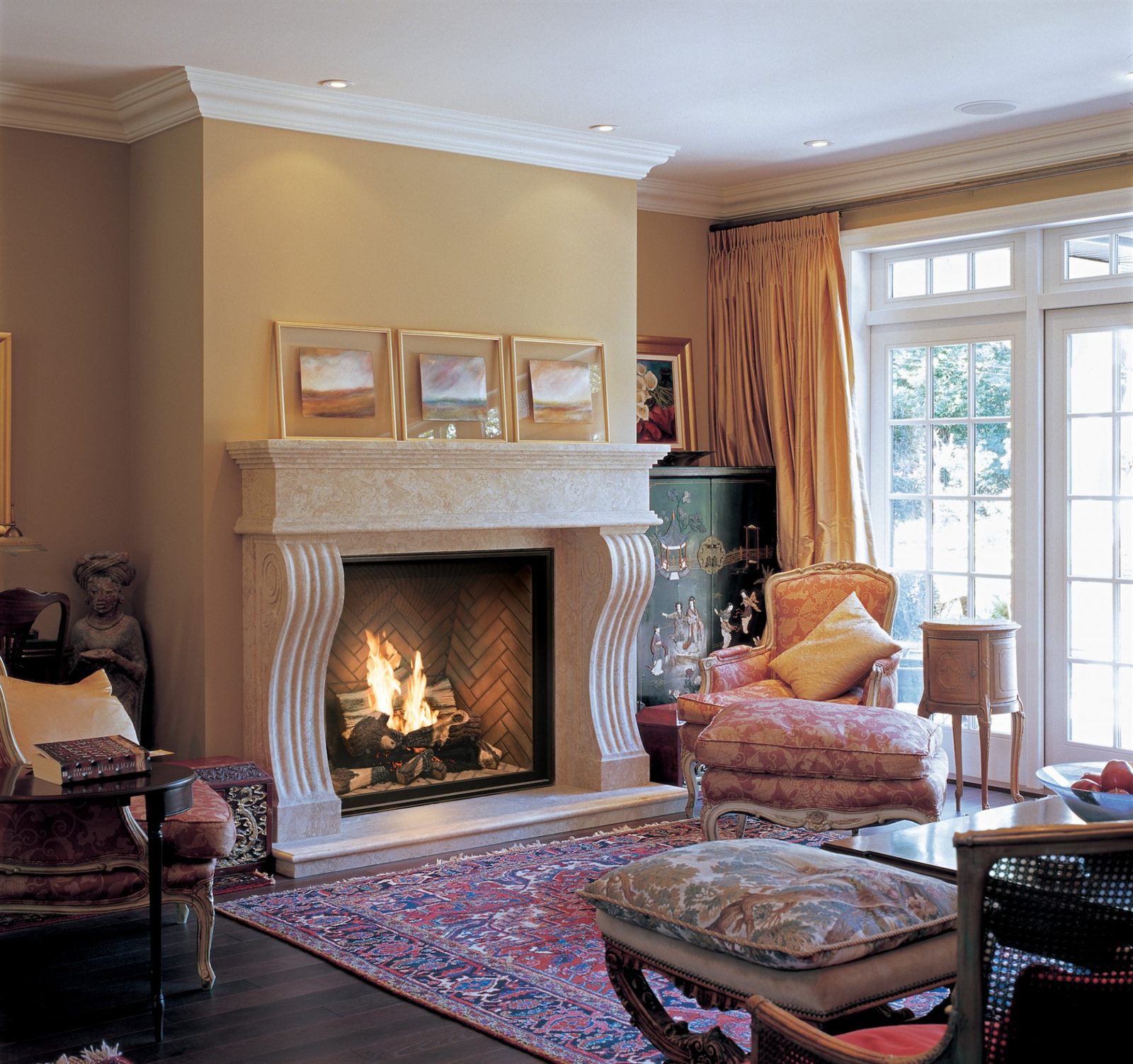
Two things make the illusion hold. The first is the glass. Town & Country uses a ceramic so non-reflective that the company calls it disappearing, and the word is fair: from an armchair you stop seeing it within a minute, and the fire reads as open. The second is the flush hearth. The fire bed sits level with the floor of the opening, where the ashes would lie in a masonry fireplace, rather than raised on a shelf behind a lip — and it is that, more than any log set, that persuades the eye. In the photograph above, the marble facing meets the opening, the mantel sits where a mantel should, and nothing between the room and the flame announces itself.
It comes in four sizes, and the sizes are the story. The TC30 is the study or the bedroom: 691 square inches of fire and a top setting of 35,000 BTU. The TC36 is the family room, at 983 square inches and 47,000 BTU, and it is the one Town & Country also builds as the TC36 Arch, with a barrel-arched face that recalls the Rumford hearths of fine period houses. The TC42 is the flagship — the fire that introduced the clean-face category — at 1,397 square inches and 61,000 BTU. And the TC54, at 2,034 square inches and 84,000 BTU, is the largest factory-built direct-vent gas fireplace made anywhere: a fire for a great room, or for the kind of lobby that would once have needed a mason.
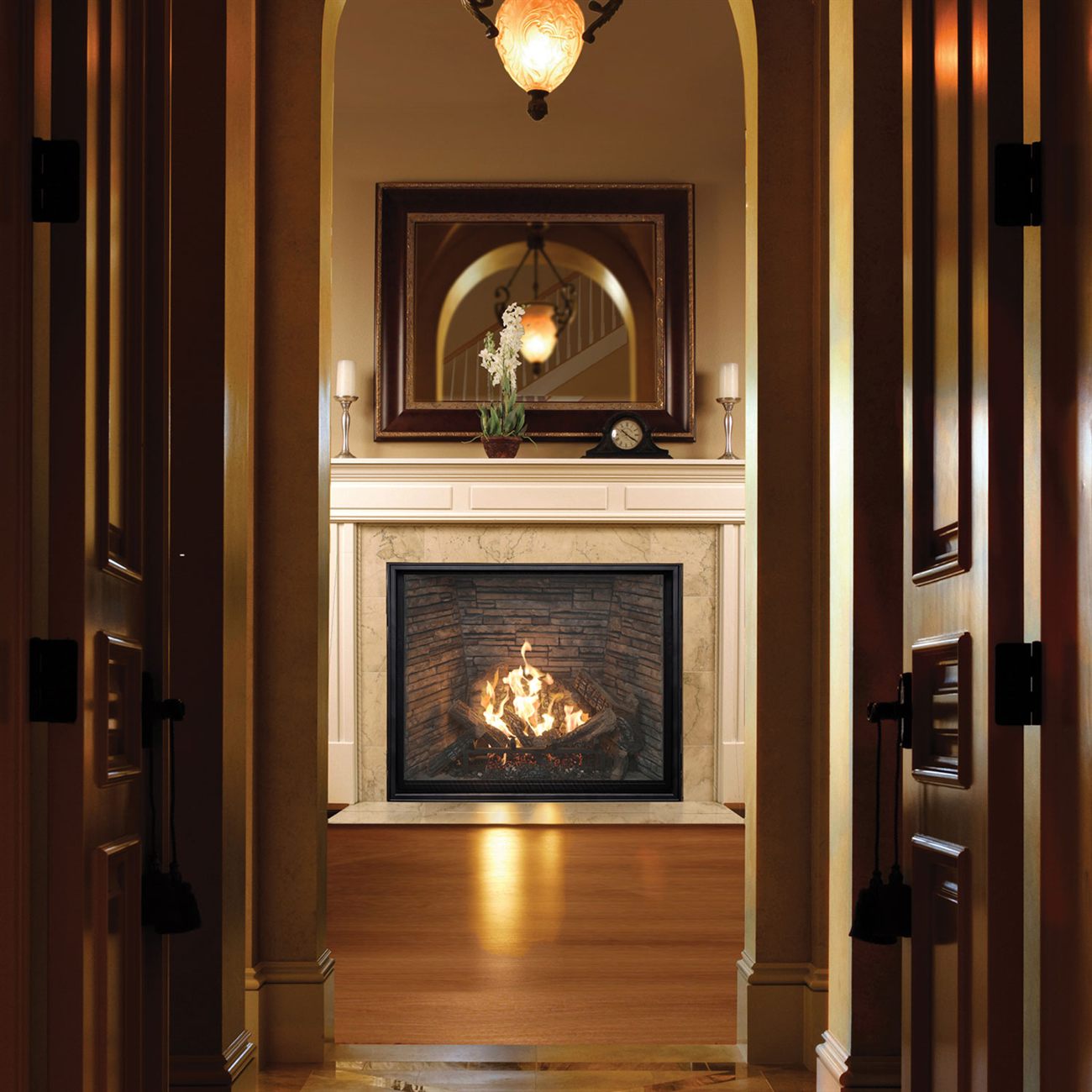
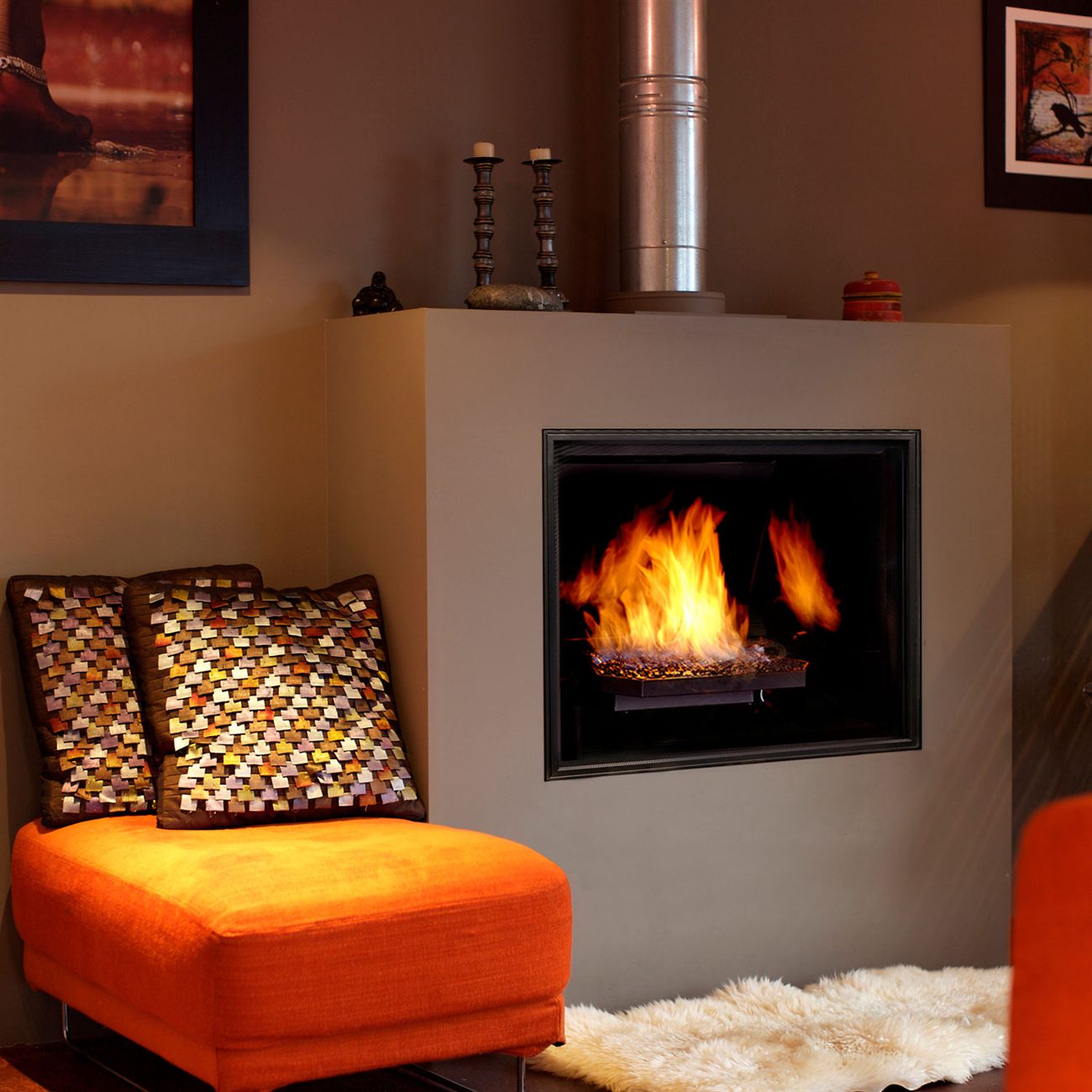
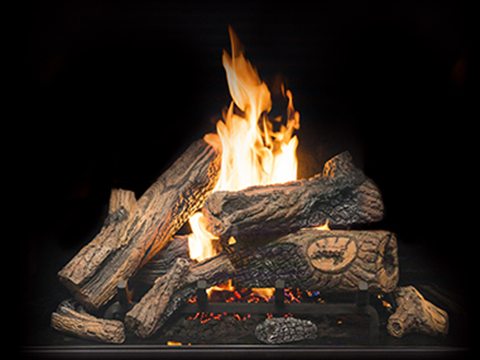
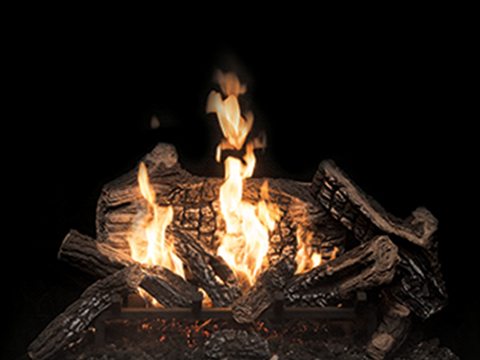
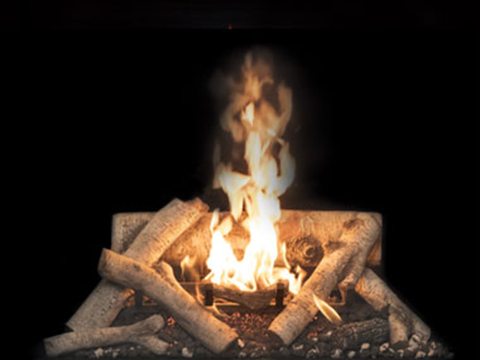
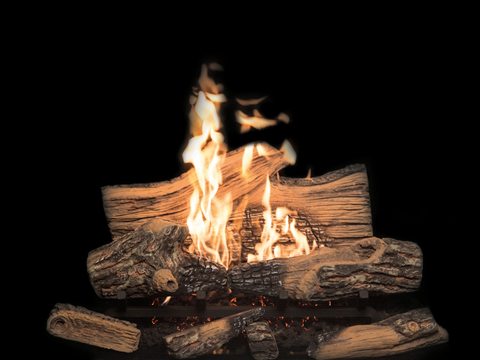
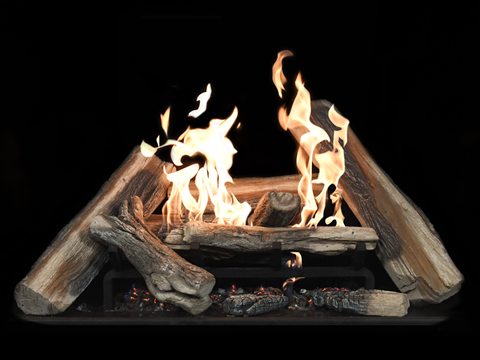
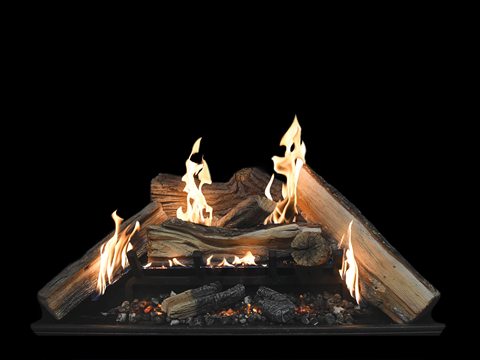
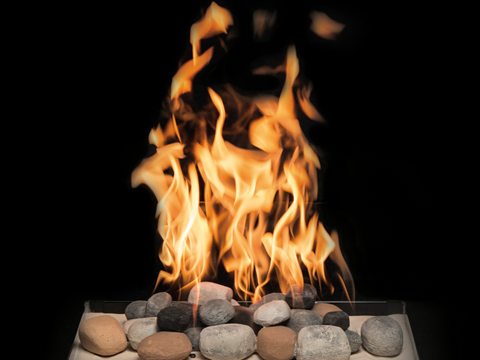
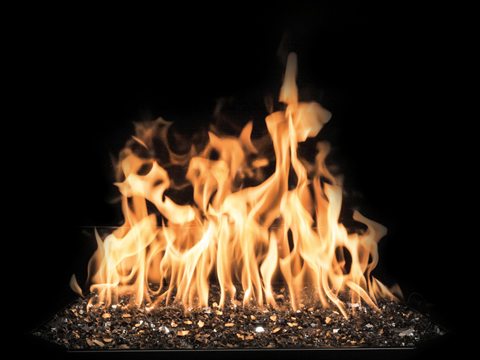
What keeps a traditional firebox from being only traditional is what Town & Country calls Design-A-Fire: the same fire, composed to the room. The burners are where it begins. Country Home, Heartwood and Birchwood are log fires of different characters, Chalet is a heavier stack of oak, and the TC42 adds a Split Log and a Split Log Heritage set; Tranquility leaves the logs out and burns over river stones, and Diamond over a bed of crushed glass. Behind the fire, the panels: Aspen, Madison, Manhattan, Mount Vernon and Park Avenue in brick and stone, or porcelain in black, coffee bean, copper and titanium. And the glass itself in four tints — Twilight, Pacific, Desert and Black. The fire in the photograph above is the same TC42 as the one beneath the mantel: Diamond burner, black porcelain, and nothing else. Two rooms, one firebox, and the choice made last.
The practical side is quietly complete. Electronic ignition with battery backup, convertible to a standing pilot at the push of a button, so the fire runs when the power does not. Natural gas or propane. Optional power venting that lets the TC30, TC36 and TC42 sit up to 110 feet from an outside wall — the TC54 up to 66 — which is what puts one of these fires in the middle of a floor plan. Control from the wall, a remote, or the phone. And on the TC42, an optional Heat Transfer Cool Wall system that carries warmth away from the surface above the fire, so the painting or the television that so often ends up there can stay.
Take the frame away, and what is left is the fire.
A clean face asks more of the people who finish the wall than a framed fire does, because there is no trim to hide behind. The stone, the tile or the plaster has to meet the opening exactly; a flush hearth means the floor finish has to meet it too; and a mantel, if there is one, has to sit at the height the fire was drawn for. The vent run — and, if it is going on an interior wall, the power vent — has to be planned with the framing rather than found afterward. That is the work Maxwell Fireplace does in-house: helping you settle which of the four sizes the room can carry and whether it wants the arch; composing the burner, the panels and the glass; drawing the vent route before a stud goes up; pulling the permits; installing; and working with the trades who build the surround so the fire and the wall are drawn as one thing. It is a handcrafted fire, and it deserves an installation to match. There is a TC36 burning in our showroom; a clean-faced fire is best judged from an armchair, and we would be glad to pull one up for you.
Questions people tend to ask
Which Town & Country fireplaces are the traditional ones?
Four sizes: the TC30, TC36, TC42 and TC54, plus the TC36 Arch, which gives the TC36 a barrel-arched face in the Rumford manner. They share the same clean face, disappearing glass, flush hearth and Design-A-Fire options and differ mainly in scale, from 691 square inches of fire on the TC30 to 2,034 on the TC54. The Widescreen, See-Thru and HeliFire models are the contemporary side of the range and are a different conversation.
What does “clean face” actually mean?
No louvres. An ordinary gas fireplace draws room air through a grille below the glass and returns it through one above, and those grilles are what make a fire in a fine room look like an appliance. Town & Country introduced the clean-face fireplace, with glass to the edge and nothing above or below it, so the finish of the wall runs right up to the opening. Nearly every clean-faced gas fire sold today follows the idea.
Can I run stone or tile right up to the edge of the fire, and hang something above it?
Yes. The clean face is designed for the finish to meet the opening, which is the point of it. For the wall above, the TC42 offers an optional Heat Transfer Cool Wall system that carries warmth away from the surface so a painting or a television can hang there. On the other sizes, what goes above the fire is a planning question we settle with you before the framing is drawn.
Does a Town & Country work in a power outage?
Yes. The electronic ignition has battery backup, and it can be converted to a standing pilot at the push of a button, so the fire lights and runs when the house has no power.
Is a Town & Country a heater, or is it mainly for the look of the fire?
It is designed around the flame first. Each size will warm the room it is in, and the top settings run from 35,000 BTU on the TC30 to 84,000 on the TC54, but these are not sealed heater fireplaces built to carry a whole floor. If heating a large space is the first requirement, that changes which fire we recommend, and we will say so plainly rather than sell you the wrong one.
Can a Town & Country go on an interior wall, away from the outside of the house?
Usually. With optional power venting the TC30, TC36 and TC42 can be installed up to 110 feet from an exterior wall, and the TC54 up to 66 feet, which is what puts one of these fires in the middle of a floor plan rather than against its edge. The vent route has to be drawn before the framing goes up, and that planning is part of what we do.
Where are Town & Country fireplaces made, and where can I see one in Vancouver?
They are designed and built in Duncan, British Columbia, by Pacific Energy Fireplace Products, and each one carries a limited lifetime warranty. A TC36 is going into our North Vancouver showroom now, and it will be lit as soon as the wall around it is finished. Come to Maxwell Fireplace, see the disappearing glass and the flush hearth for yourself, and we will walk you through the four sizes and the Design-A-Fire options. We serve the North Shore, Vancouver and the Sea to Sky corridor.