← Back to Gas Inserts
A Creative FireSpace™ · 10 September 2026
Enviro Gas Inserts — The Fireplace You Have, Warm Again
Nine direct-vent gas inserts, from a 20,000 BTU fire for a small opening to a 42,000 BTU heater for a great room, built to make an old masonry fireplace heat the house.
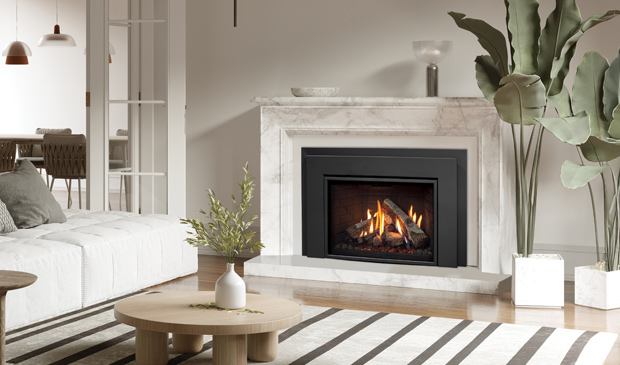
The masonry fireplace is the one feature of an older house that everybody wants and almost nobody uses. Lit, it pulls the warm air of the room up the chimney faster than it makes any; unlit, it sits at the centre of the wall doing nothing at all. A great many of the households we work with do not want wood — the splitting, the storing, the sweeping, the smoke — and a great many strata buildings will not allow it. What they want is the fireplace, warm, on a Tuesday, from the sofa.
That is what a gas insert is for. It is a sealed steel firebox behind ceramic glass that slides into the opening you already have, breathes through two flexible liners run up the old chimney, and closes the rest of the hearth with a surround plate. Nothing from the fire enters the room and no room air leaves it, which is why the coldest thing in the house becomes the warmest, with a thermostat, a remote, and no wood to carry.
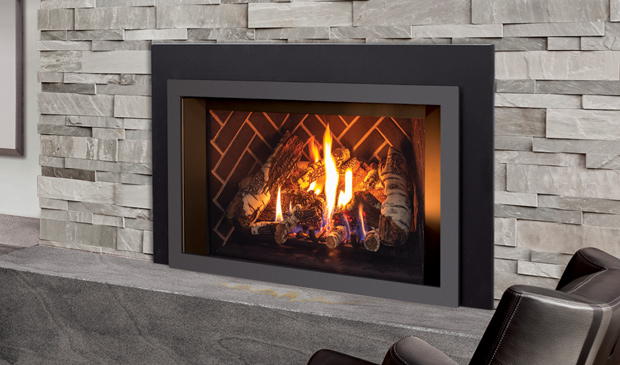
Enviro builds nine of them, in Saanichton, British Columbia — it is the company behind Urbana, whose outdoor fires we wrote about earlier — and what the nine share is more telling than what separates them. Every one has a clean face with no louvres, so the surround reads as a frame around the fire rather than a grille. Every one lights electronically from a remote, with a valve that turns the flame down to half or less, and a convection fan that carries the warmth into the room. The log sets are the high-definition kind that hold up at arm’s length, and on the EX models and the Ri30 an ember bed lit from beneath glows on after the flame has been turned down. Enviro backs the newer models with a limited lifetime warranty.
The nine sort themselves by the fireplace. The Q1 is for the small opening — the tall, narrow hearth of an older bedroom or a townhouse — with 20,000 BTU behind a window of glass taller than it is wide, and a Victorian cast face for a house that has one. The E20 and E25 suit the modest hearth. The middle of the range — the E30, the EX32 and the Ri30, whose flames rise up through the logs rather than in front of them — fits the ordinary full-size opening at a little over 32,000 BTU. The E33 and EX35 are the ones most of the homes we work in end up with: 27 inches of fire, 34,000 to 35,000 BTU, rated by Enviro for 1,800 to 1,900 square feet. And the E44 is the large room’s insert, with 29 by 21 inches of glass, 42,000 BTU and a fan half again as strong as the others.
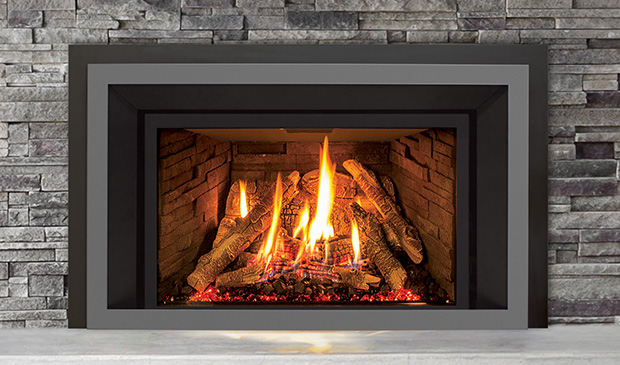
Because the surround covers what is left of the old opening, it becomes the face of the fireplace, and Enviro treats it that way. There is a cast surround with a raised border, a contemporary one with a flat plane, a designer version in powder-coated grey, a Forgeworks face in midnight bronze, a Galiano in brushed graphite, a slim surround for a tight opening and an oversize one for a wide hearth, and trimmable filler panels for the fireplace that was never built square. Behind the fire, the liner: black enamel, red or grey brick, fluted, herringbone or ledgestone. The burner carries a log set or, on most models, glass. Natural gas or propane. Remote or thermostat. The E33 can even be set up with a standing pilot for the household that wants the fire to light when the power is out.
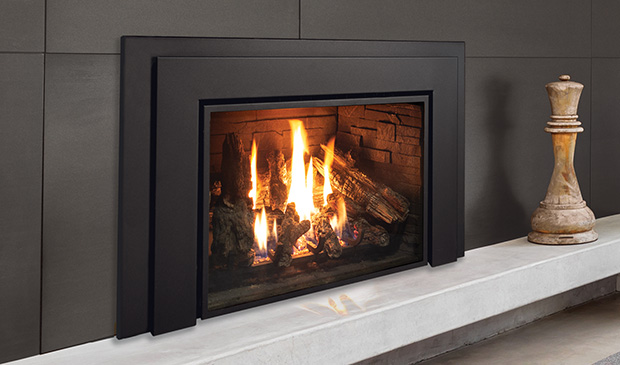
The photograph above is the E44 in a modern room, and the one before it the EX35 in stone; the first on this page is the Ri30 under marble. That is the quiet point of an insert. The fireplace was built long before anyone chose a fire for it, and the insert is what lets the fire be chosen now — to the room, to the wall, to the way the household actually lives around it — without touching the masonry at all.
The chimney stays. The cold air stops.
A gas insert is chosen by three measurements and a chimney. The opening has to be wide, tall and deep enough for the firebox — Enviro publishes a depth range for each model, and the surround you choose can change the minimum — and the flue has to take two liners for its whole height and be sound enough to carry them. Then there is the gas line to the hearth, the power for the ignition and the fan, and the surround to be chosen against the wall it will sit on. That is the work Maxwell Fireplace does in-house — measuring the firebox and inspecting the chimney before we recommend a size, choosing the surround and the liner with you, running the liners and the gas, pulling the permits, and installing it with our own crew. Bring us a photograph and the three measurements of the opening, and we will tell you which of the nine it can hold.
Questions people tend to ask
Will a gas insert fit the fireplace I already have?
Almost always, and the measuring is where we start. Enviro’s inserts run from the Q1, which needs an opening only 20¼ inches wide and 27½ tall and about 13 inches deep, up to the E44, which wants 34½ by 24 inches and nearly 21 inches of depth. The plate that surrounds the insert closes whatever is left of the old opening, and trimmable filler panels cover the awkward ones. We measure the width, height and depth of the firebox and the state of the chimney before we recommend a model.
How does a gas insert vent?
Through the chimney you already have. Two flexible liners run up the old flue, one bringing combustion air down and one carrying exhaust out, and the insert is sealed behind ceramic glass, so nothing from the fire enters the room and no room air is drawn up the chimney. That sealed, direct-vent design is the whole reason an insert heats a house where an open fireplace cooled it.
Will it actually heat the room, or is it decorative?
It heats. Enviro rates its inserts by the area they will warm, from about 1,100 square feet for the Q1 to 2,300 for the E44, with a convection fan that pushes the warmth into the room and a valve that turns the fire down to half or less for a mild evening. Most of them can be run from a thermostat, so the insert holds the room at a temperature rather than simply burning. Match the size to the room and it will carry the floor it sits on through most of a winter.
Does it work in a power outage?
The fan does not, but the fire can. The E33 can be ordered with a standing pilot, which lights without electricity, and the electronic-ignition models are set up so the fire can still be lit when the power is out. Tell us if that matters in your house and we will specify the ignition accordingly.
Should I choose a gas insert or a wood insert?
It depends on what you want from the fireplace. A wood insert gives you a real wood fire and heat that owes nothing to the utility, at the cost of wood to store and a chimney to sweep; we wrote about Pacific Energy’s wood inserts separately. A gas insert lights from a remote, holds a thermostat, needs no wood and no sweeping, and is the better choice where the fireplace is used most evenings rather than on occasion. Both retrofit into the same masonry opening, so the fireplace itself rarely decides it.
Where are Enviro inserts made, and where can I see one in Vancouver?
They are built in Saanichton, British Columbia, by Sherwood Industries, the company that also makes Urbana. Come to Maxwell Fireplace in North Vancouver and we will walk you through the nine inserts, the surrounds and the liners, and take the measurements that decide which one your fireplace can hold. We serve the North Shore, Vancouver and the Sea to Sky corridor.