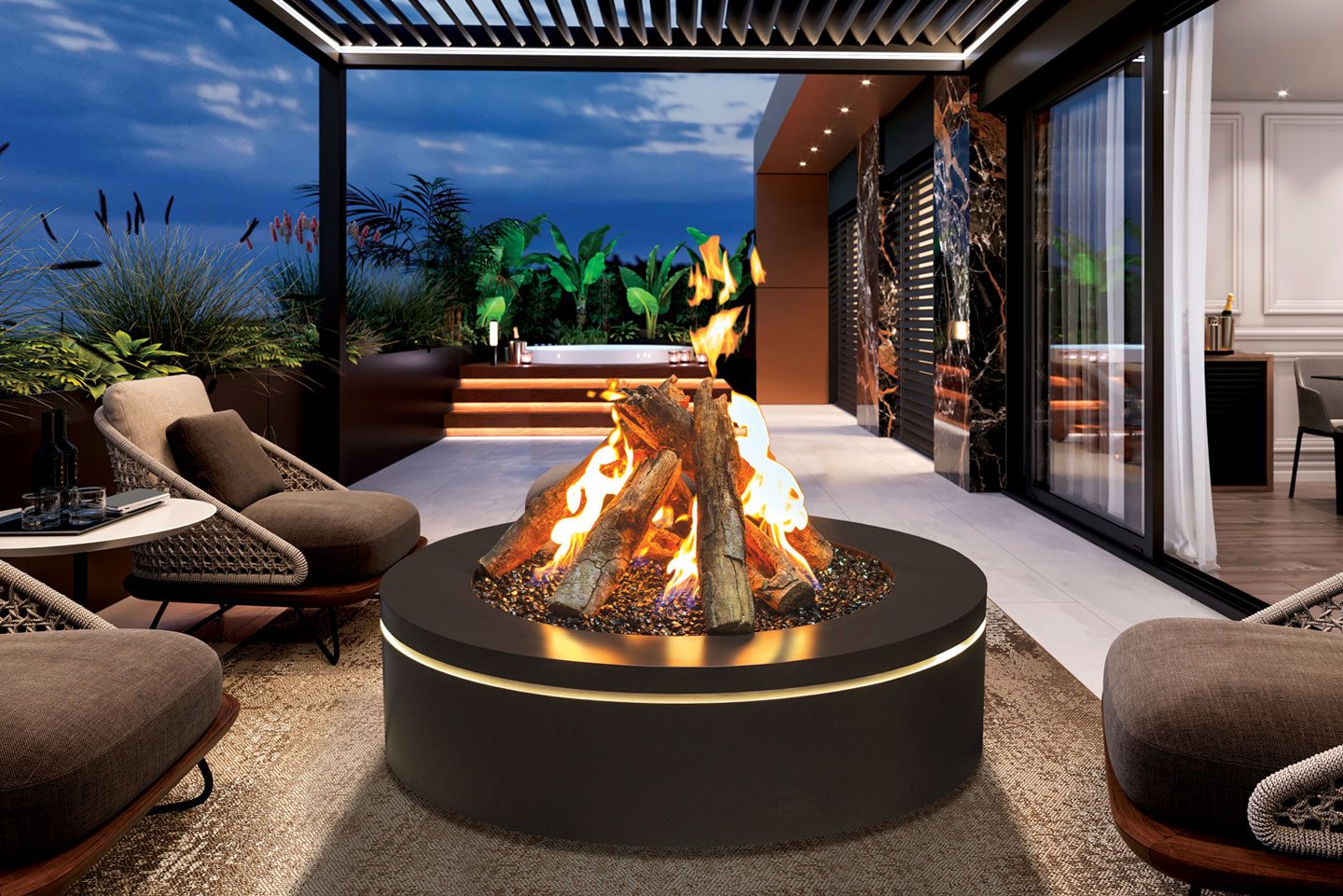
Three weatherproof gas fireplaces and a family of fire pits, built for the terrace, the pool deck and the covered porch — no flue, no wood, and nothing to bring in at the end of the night.
Every house has a room it forgot to finish. It is the terrace off the kitchen, the covered porch, the corner of the garden with the good chairs — the place the household drifts to on the first warm evening and abandons at the first cold one. What turns it into a room is not a roof or a wall. It is a fire. A fire gives the space a centre, gives people a reason to face one another, and quietly adds two months to either end of the season in which anyone wants to be outside after dark.
Wood does this badly outdoors. It smokes the neighbours, it sparks, it has to be stored and split and carried, and in most of the municipalities we work in it is restricted or banned for much of the year. Gas does it well. Urbana, the luxury fireplace line built in Saanichton, British Columbia, by the company behind Enviro, makes three outdoor fireplaces and a family of fire pits for exactly this room — in stainless steel and weatherproof finishes, with no venting at all, an auto shut-off, and a burner that lights from a switch and goes out from one.
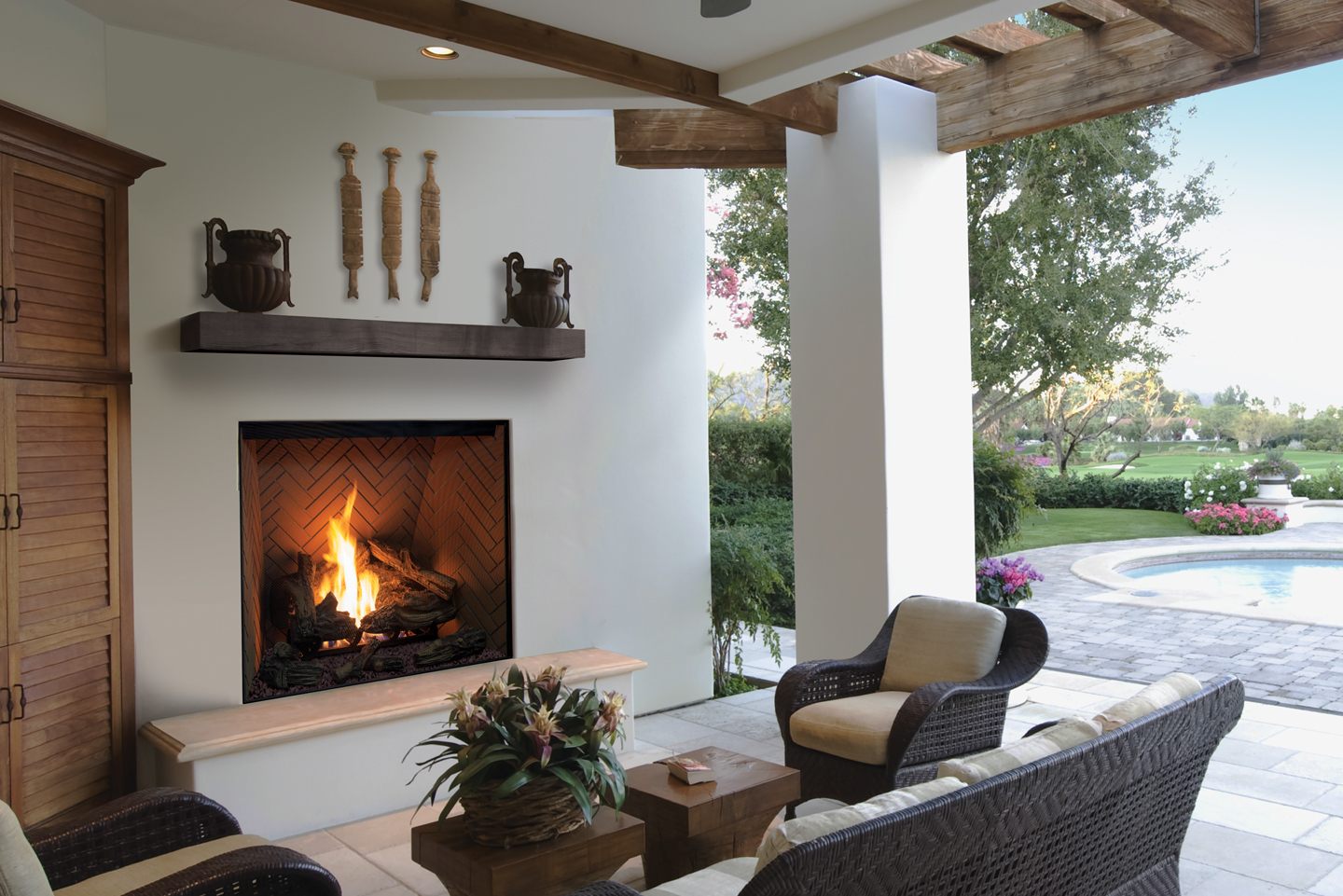
The U44 Outdoor is the traditional one, and it is built the way Urbana builds its indoor fireplaces: a clean face with no louvres, so the stone or stucco of the porch wall runs right to the opening. The fire is open — 41 inches wide and 36 tall — over a three-dimensional stainless burner that stacks the flame the way a real log fire does, on a traditional or birch log set, against a liner of rustic brick, herringbone in dark umber or sandstone, ledgestone, black enamel or stainless. It runs to 63,000 BTU on natural gas and comes with a steel weather cover for the months it is not in use. In the photograph above it is doing what this kind of fire does best: sitting under a roof, at the end of a room that happens to have no fourth wall, being looked at from a chair.
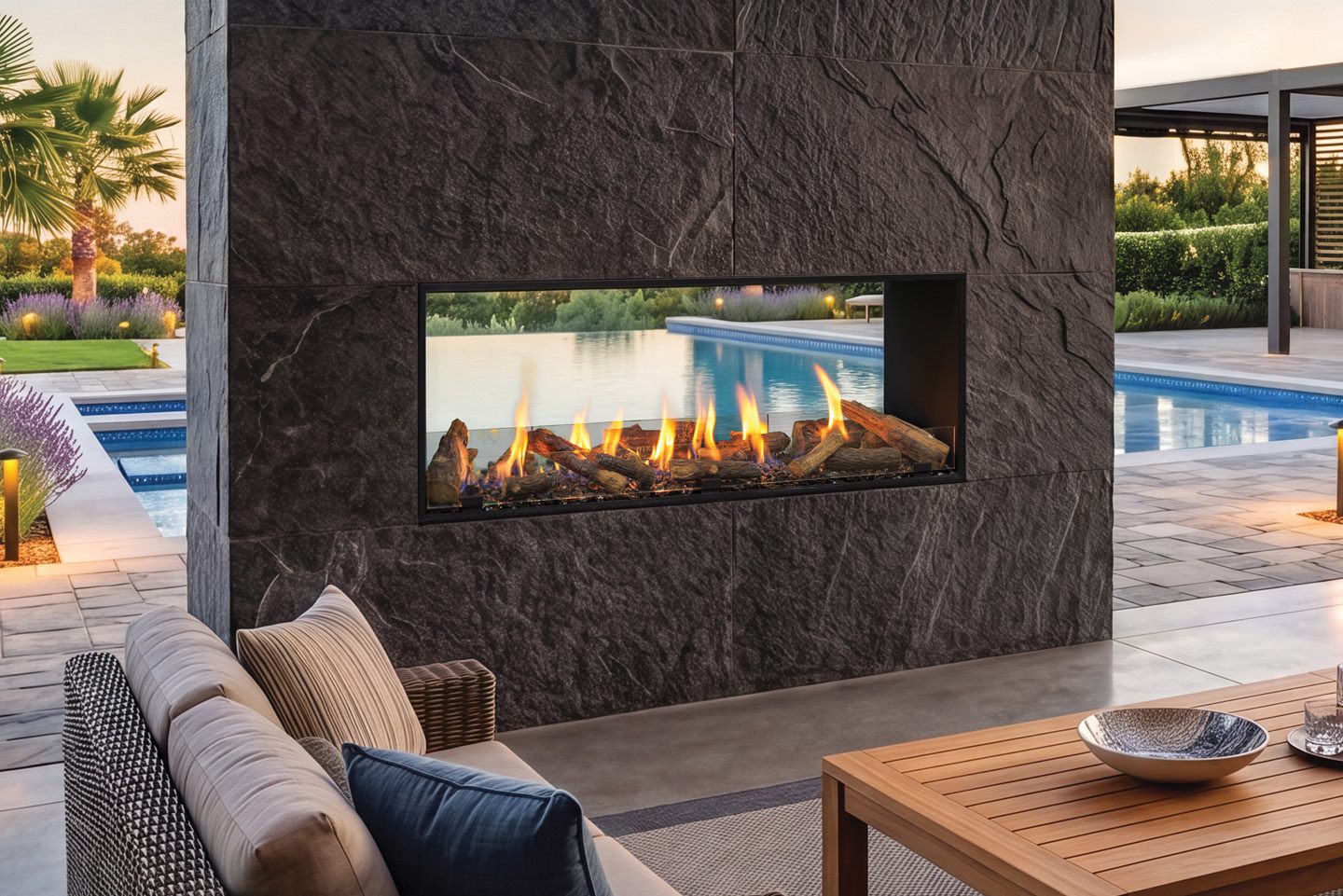
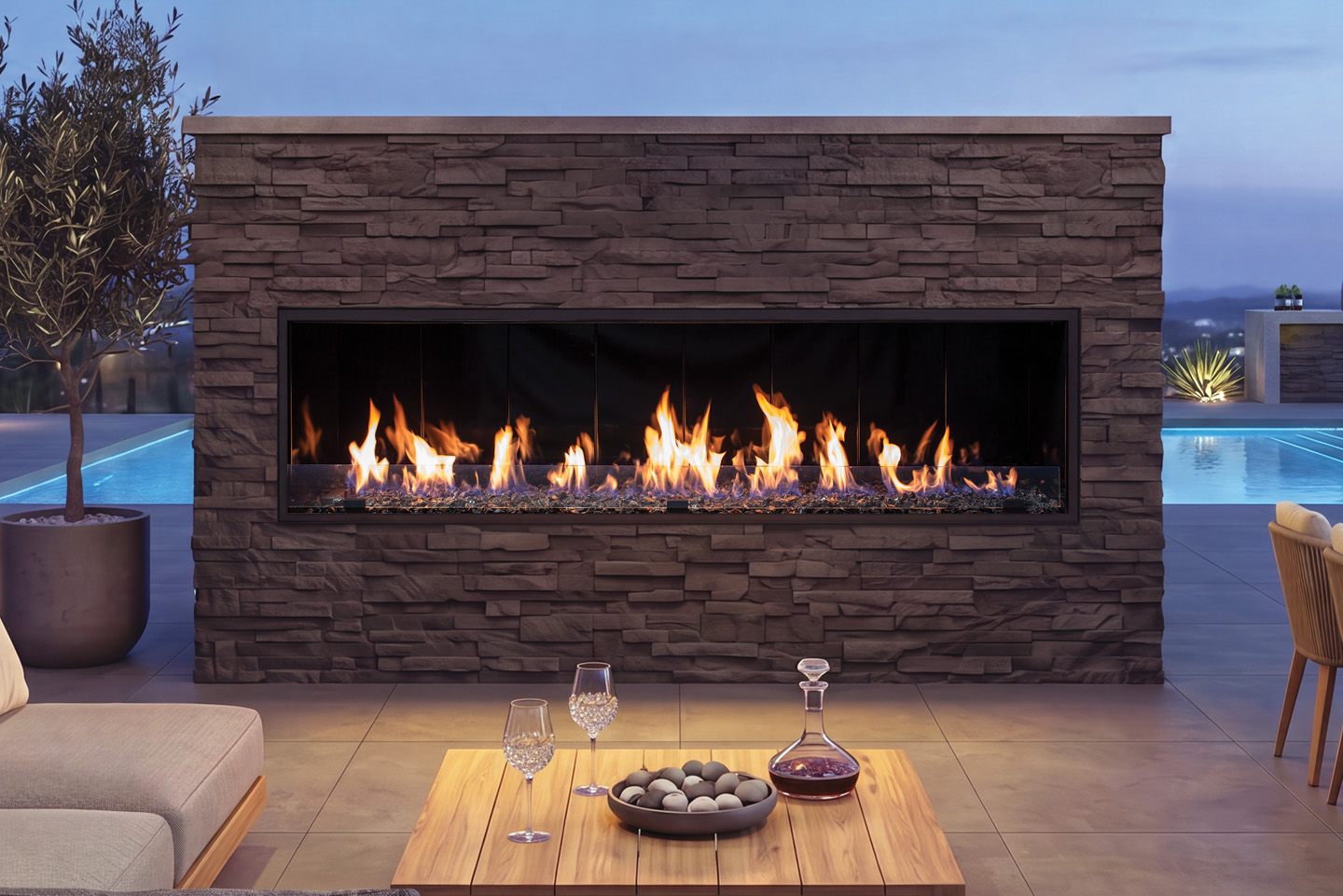
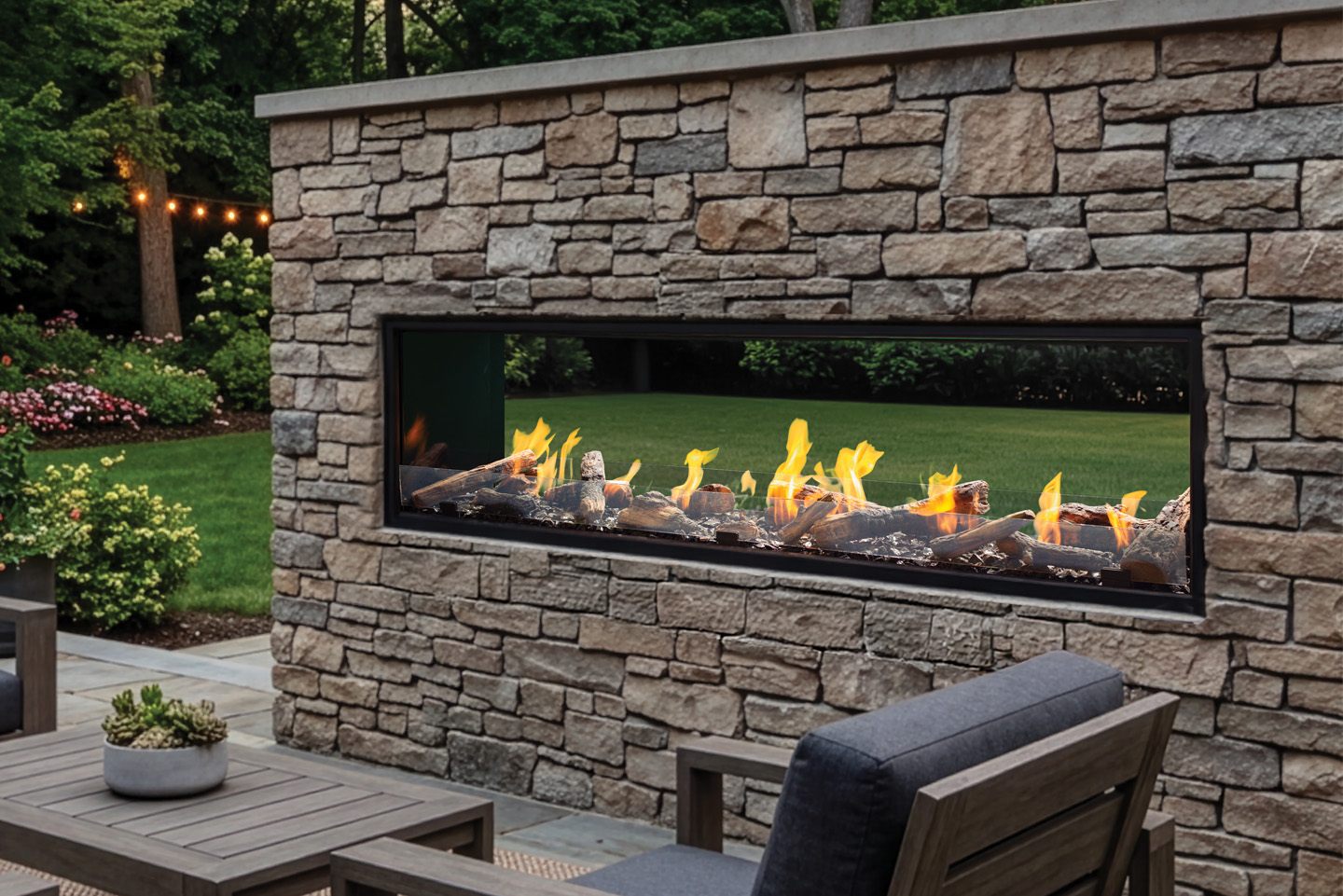
The U60 and U74 Outdoor Linear are the modern ones: a low, wide line of fire, 59 and 74 inches across and 19 inches tall, with 78,000 and 94,000 BTU behind it. Both are built to install either single-sided or straight through a wall, which is the trick worth building a garden around. A pier between the dining terrace and the pool deck, a low wall between the porch and the lawn — one fire, seen from both sides, with the far side of the garden visible through the flame. The fire bed is crushed black glass or charcoal lava rock, or a traditional, birch or driftwood log set laid along it; the liner is black enamel or stainless, in see-through versions for the pass-through installs. And because a linear fire outdoors collects leaves as readily as any other ledge, both come with an off-season debris panel that closes the firebox for the winter.
And then there are the fire pits, which Urbana calls Halo: a 40-inch round, a 47-inch round, a 41-inch round in concrete, a 44-inch square faced in brick, and a 60-inch linear. They are not the flimsy tables of the patio store. The chassis is heavy-gauge stainless steel, hand-welded; the burner is Urbana’s stainless Spyder, adjustable in height and clean-burning; the ignition is a hot-surface igniter on a 24-volt valve with an auto shut-off; and a ring of soft white LED light runs beneath the rim so the pit reads as an object even before the fire is lit. The Halo 40 alone runs to 170,000 BTU, which is the difference between a fire you look at and one you gather around in November. Glass, black diamond glass, lava rock or a split-log set fill it; a glass wind guard, levelling legs, drainage and a fitted cover are the parts that let it live outside.
The garden was always a room. It only needed a fire.
An outdoor fire is easier to vent than an indoor one and harder to place. There is no flue to plan, but there is a gas line to run to the far side of a garden, a power supply for the ignition, wind to think about on an exposed deck, clearances to honour under a porch roof, and drainage so a stone-built wall does not hold water behind a stainless firebox. The clean-face opening has to be finished as precisely outdoors as in, in materials that will take a winter. That is the work Maxwell Fireplace does in-house — helping you settle which of the three fireplaces or five fire pits the space wants, drawing the gas and electrical runs with the landscaper before the paving goes down, checking the installation guide against the actual roof and the actual wind, pulling the permits, installing, and returning to light it with you on the first evening it is warm enough to sit out.
Questions people tend to ask
Does an outdoor gas fireplace need a chimney or a vent?
No. The Urbana U44 Outdoor, U60 and U74 are built to burn in the open air and need no venting at all, which is what lets them sit in a garden wall, a pool-side pier or the back wall of a covered porch where a flue could never run. What they do need is a gas line, a power supply for the ignition, and the clearances the manual sets out, all of which are planned before the wall is built.
Can I put one under a covered porch or a roof?
Yes, provided the clearances above and around the opening are honoured, and that is a planning question rather than an afterthought. A roof changes how heat and combustion gases move, so the height of the ceiling, what it is made of and how open the sides are all matter. We check the installation guide against the actual structure before we recommend a model, and we will tell you plainly if a space needs to change.
How much warmth does an outdoor fire actually give?
More than you would expect and less than a heater. The U44 runs to 63,000 BTU on natural gas, the U60 to 78,000, the U74 to 94,000 and the Halo 40 fire pit to 170,000, and because they are open fires the warmth is radiant: you feel it on the side facing the flame. An outdoor fire is for extending the evening and the season, not for heating the outdoors, and the pleasure of it is in sitting close.
What happens to it in winter?
It stays where it is. The fireplaces are built in stainless steel and weatherproof finishes; the U44 comes with a steel weather cover, the U60 and U74 have an off-season debris panel that closes the firebox, and the Halo fire pits have a fitted cover, drainage and rust-resistant fittings. The burner and the media can stay out all year, and the fire lights again the first dry evening of spring.
Why gas rather than a wood fire outdoors?
Smoke, mostly. A wood fire outdoors smokes the neighbours as surely as it does you, and open burning is restricted or banned in most of the municipalities we work in for much of the year, with further bans in fire season. A gas fire has no smoke, no sparks and no wood to store, can be turned off with a switch, and is generally treated as an appliance rather than an open fire by local rules. We will tell you what applies where you live before anything is ordered.
Where are Urbana fireplaces made, and where can I see one in Vancouver?
They are built in Saanichton, British Columbia, by Sherwood Industries, the company behind Enviro. Come to Maxwell Fireplace in North Vancouver and we will walk you through the three outdoor fireplaces, the Halo fire pits and the liners, log sets and media that suit each. We serve the North Shore, Vancouver and the Sea to Sky corridor.