← Back to Wood-Burning Stoves & Fireplaces
A Creative FireSpace™ · 21 November 2026
Valcourt Wood Fireplaces — Built Into the Wall, Made to Burn Clean
Seven high-efficiency wood fireplaces from Quebec, each EPA 2020 certified, and one guillotine fireplace made for the pleasure of the fire alone — with the difference between them stated on the page.
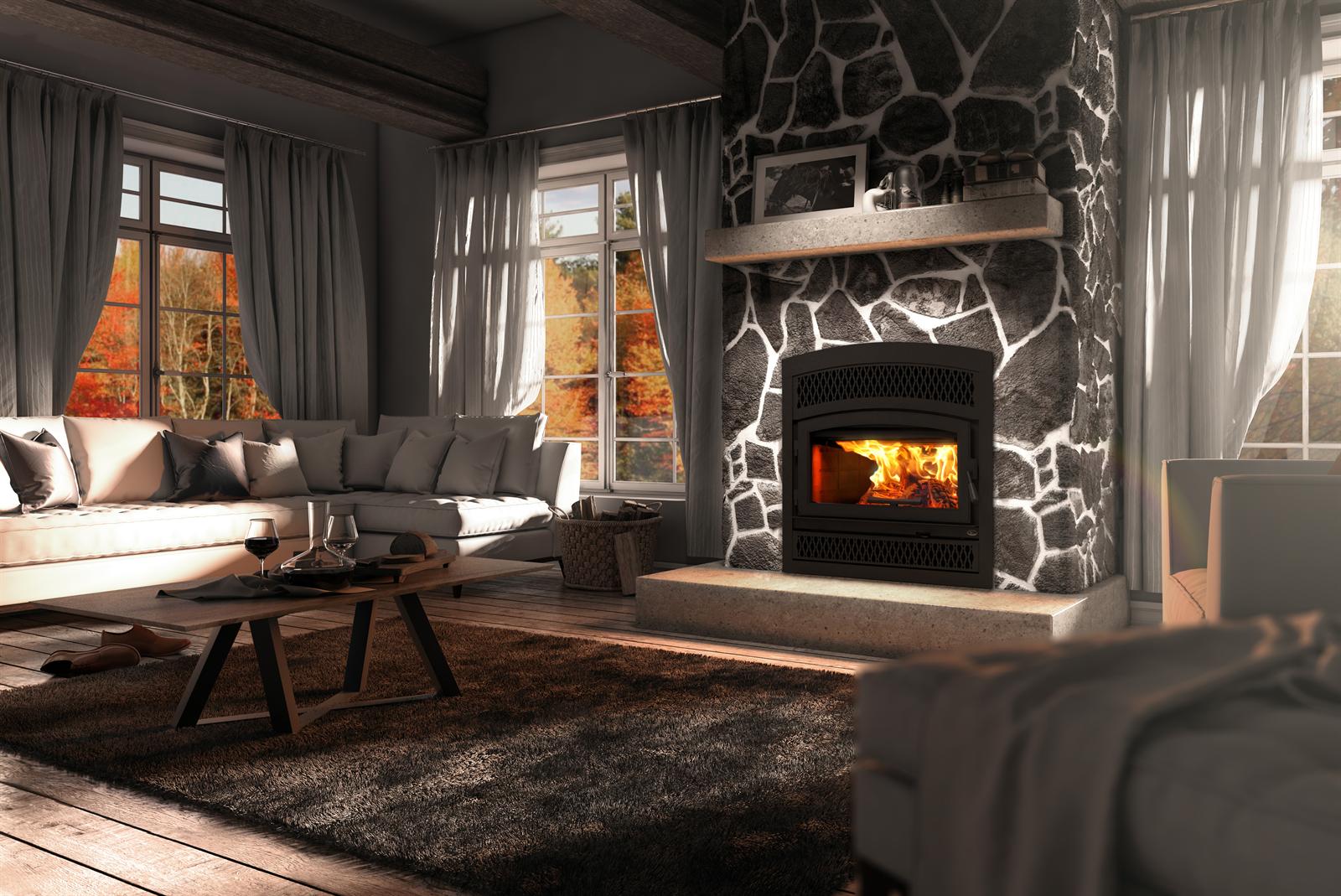
Valcourt makes one thing. There is no stove in its catalogue and no insert: every model is a wood fireplace built into a framed wall, a firebox in a steel casing that is vented through a listed chimney and finished like any other part of the room. By Valcourt’s own account the company began in 1958 as an ornamental ironwork shop in Quebec, turned to fireplace doors in 1975, and built its first wood fireplace in 1992. The fireplaces are still made in Quebec, by people who have spent a long time thinking about doors.
That last point is not a small one. A fireplace is mostly a door: how it opens, how much glass it carries, where it goes when you want the fire to yourself. Valcourt’s range can be read as a set of answers to that question — a single door under an arch, a pair of doors in cast iron, doors that slide away into the sides of the firebox, and a sheet of glass that sinks out of sight beneath the hearth.
Begin with the question that ends most wood-fire projects before they start. Seven of the eight fireplaces on this page are certified to the EPA’s 2020 standard, which is one of the two standards Metro Vancouver’s Bylaw 1303 accepts, alongside CSA B415.1. Valcourt publishes between 1.2 and 1.9 grams of particulate an hour for them, model by model, and the figure for each is given below. That makes each of the seven eligible to be registered and burned inside the Urban Containment Boundary. The eighth, the Antoinette, is a different kind of fireplace under the bylaw, and it has a section of its own further down.
Lafayette II & Lafayette IIS
FP10R · FP10RS · EPA 2020 · 1.2 g/h · 2.5 cu ft firebox · 6-inch chimney
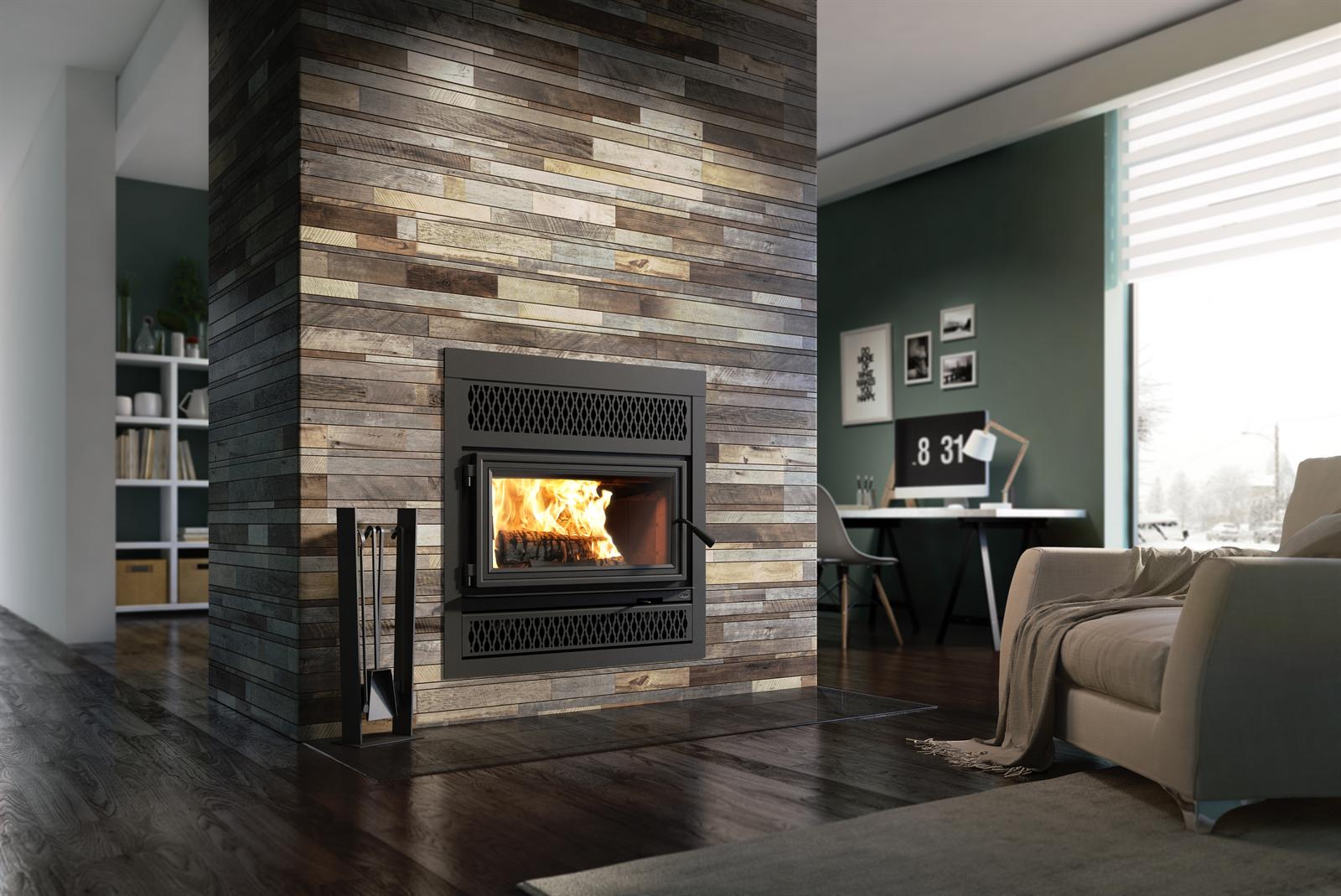
The Lafayette II is the one most rooms are looking for: a single glass door, a firebox of 2.5 cubic feet that takes logs up to 20 inches, and a face that reads as a fireplace from across the room. Valcourt rates it at up to 80,000 BTU an hour on dry cordwood, with a tested range of 12,700 to 60,700, a burn of up to eight hours on a load, and a heating area of 750 to 2,200 square feet. A blower is included. The Lafayette II wears an arched faceplate; the Lafayette IIS is the same fire behind a square one. Either can be finished with one of five louver styles and a door overlay in black or brushed nickel.
Mundo II
FP12R · EPA 2020 · 1.2 g/h · 2.5 cu ft firebox · 6-inch chimney
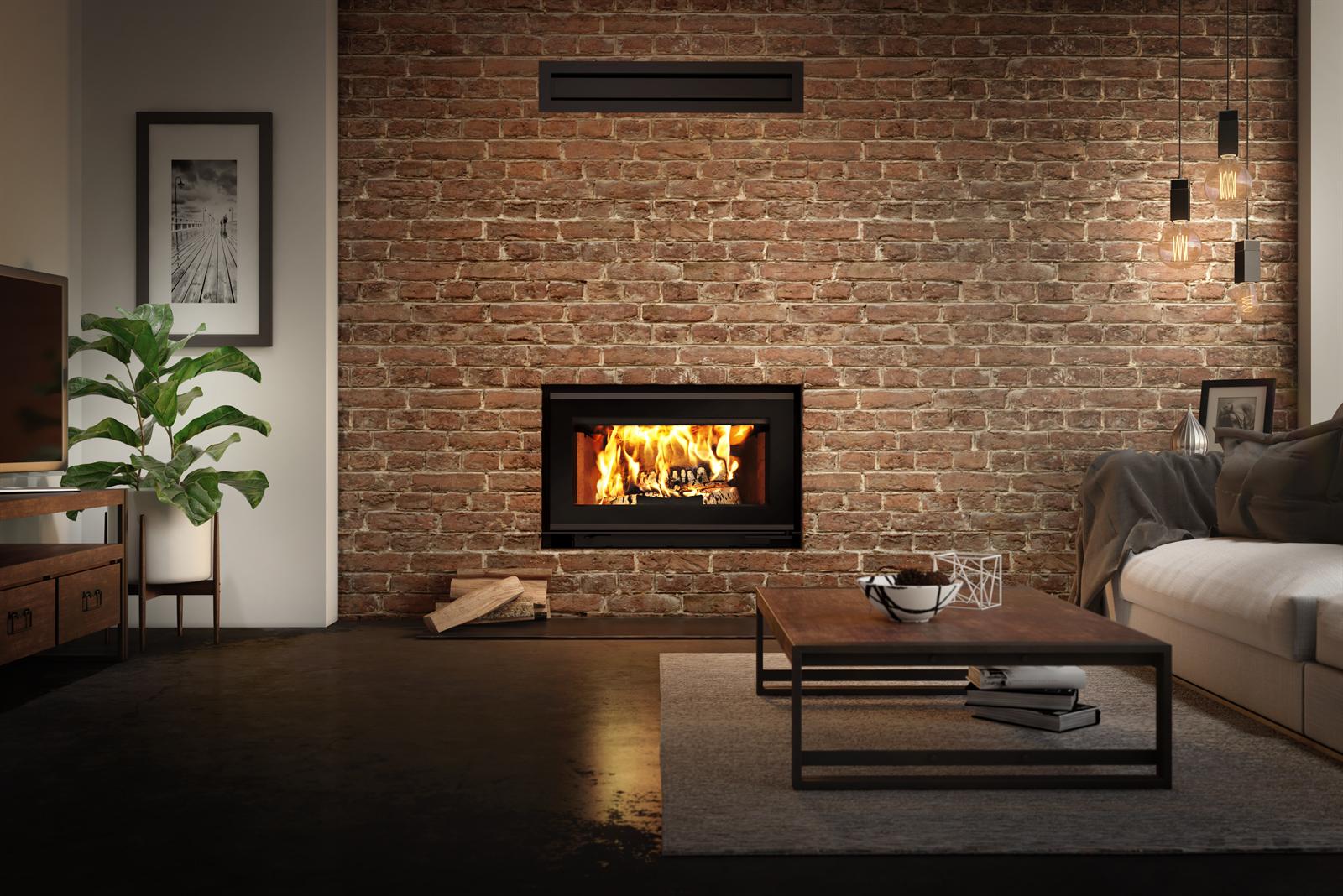
The Mundo II is the Lafayette’s fire with the ornament taken away. The firebox, the output and the emissions figure are the same; what changes is the face, which has no louvers at all — a door and a plain surround, for a wall of plaster, stone or tile that would rather not be interrupted. The warm air leaves instead through a gravity kit, which carries it up inside the wall to grilles set higher, in a traditional or a modern pattern. Valcourt offers the door with its NightFlame glass, a semi-transparent black ceramic that hides the firebox when the fire is out and clears when it is lit.
Waterloo & Waterloo Arched
FP15 · FP15A · EPA 2020 · 1.6 g/h · 4.28 cu ft firebox · 8-inch chimney
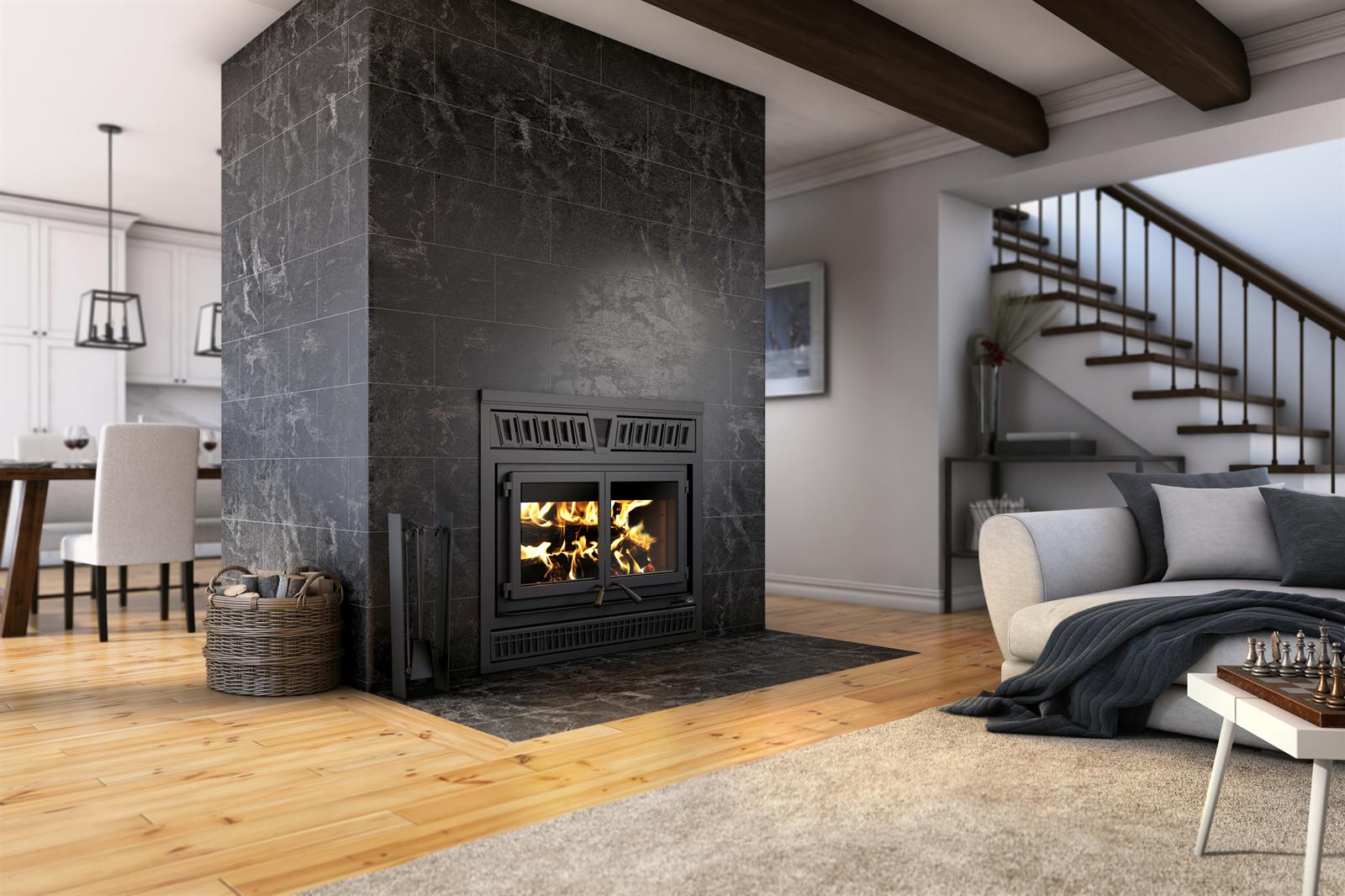
The Waterloo is the largest of the high-efficiency fireplaces, and it is built for the large room and the long evening. Two glass doors framed in cast iron open on a firebox of 4.28 cubic feet that takes logs up to 25 inches. Valcourt rates it at up to 95,000 BTU an hour on dry cordwood, with a tested range of 16,900 to 43,000, a burn of up to eleven hours, and a heating area of 1,000 to 2,800 square feet. Its air control is patented: once the fire is established and the first damper is closed by hand, the fireplace closes the second by itself when the firebox reaches its working temperature. A blower is included. The Waterloo comes with a crown-style faceplate; the Waterloo Arched is the same fire with an arched face and a louver.
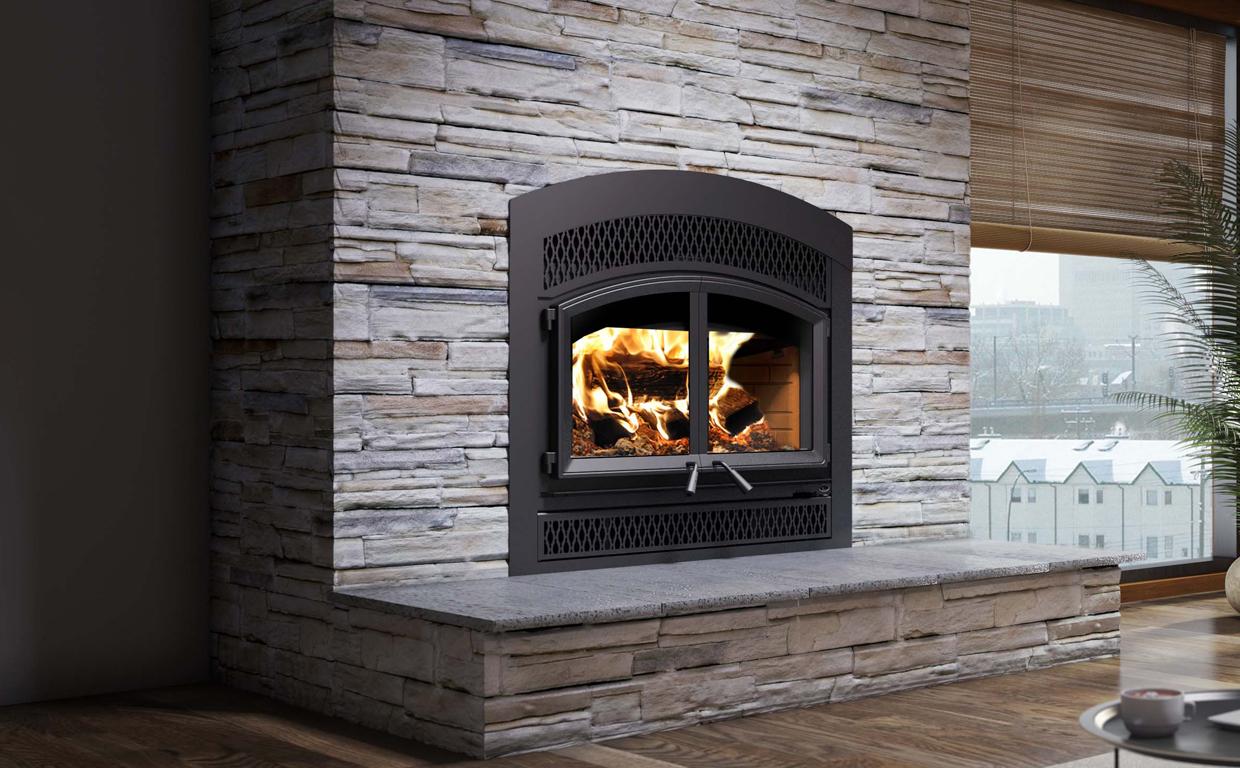
Dallaire
FP18R · EPA 2020 · 1.9 g/h · 3.04 cu ft firebox · 6-inch chimney
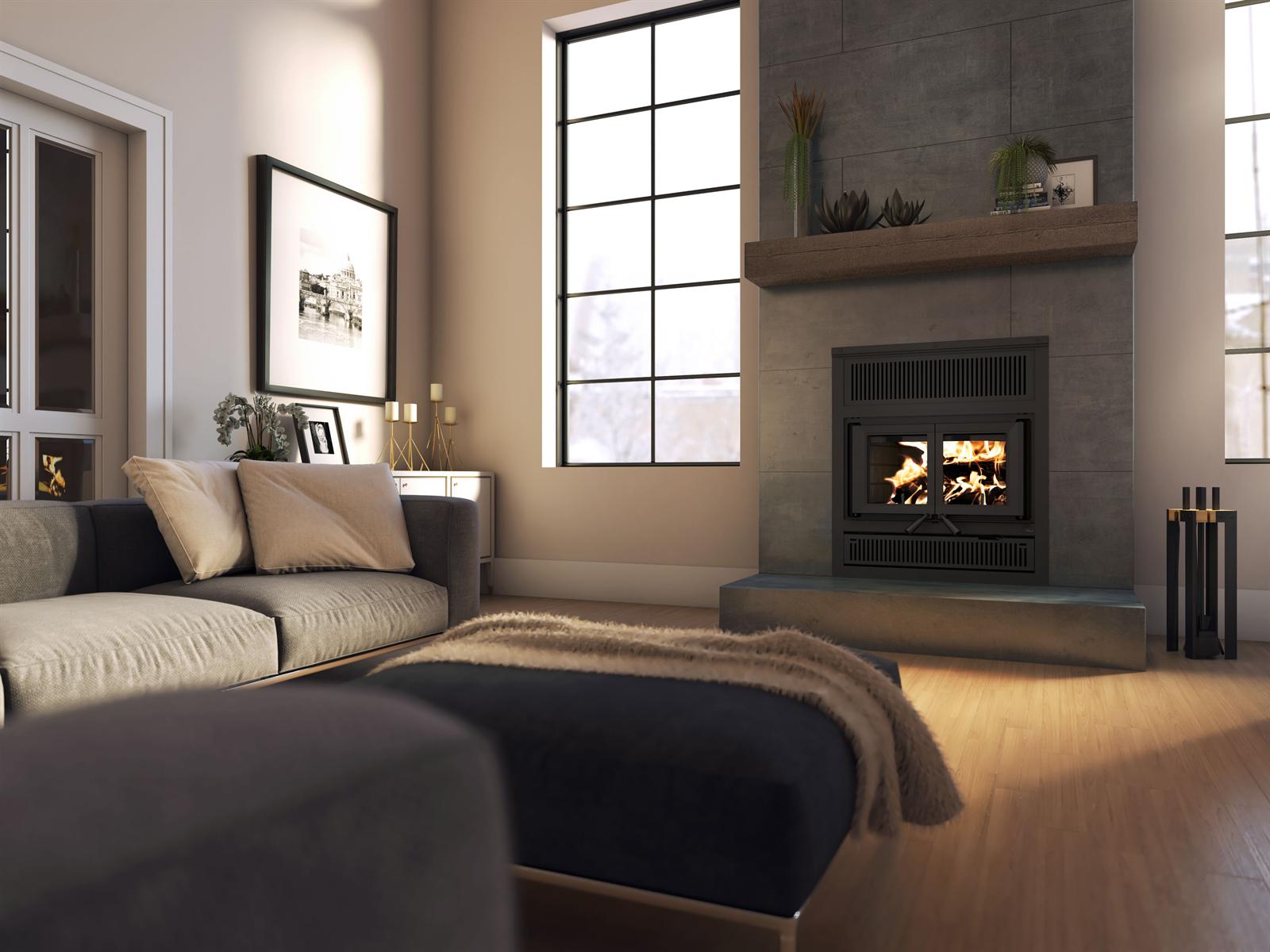
The Dallaire is the one with the disappearing doors. Its two cast-iron doors do not swing out into the room; they slide away into the sides of the firebox, which Valcourt describes as unique on the market. Closed, it is a certified high-efficiency fireplace: 3.04 cubic feet, logs up to 20 inches, up to 85,000 BTU an hour on dry cordwood with a tested range of 25,900 to 78,200, a burn of up to eight hours, and a heating area of 750 to 2,500 square feet. Open, with Valcourt’s optional firescreen in place, it is an open fire for an hour — and then the doors come back and it is a heater again.
St-Louis
FP19 · EPA 2020 · 1.8 g/h · 3.15 cu ft firebox · 8-inch chimney
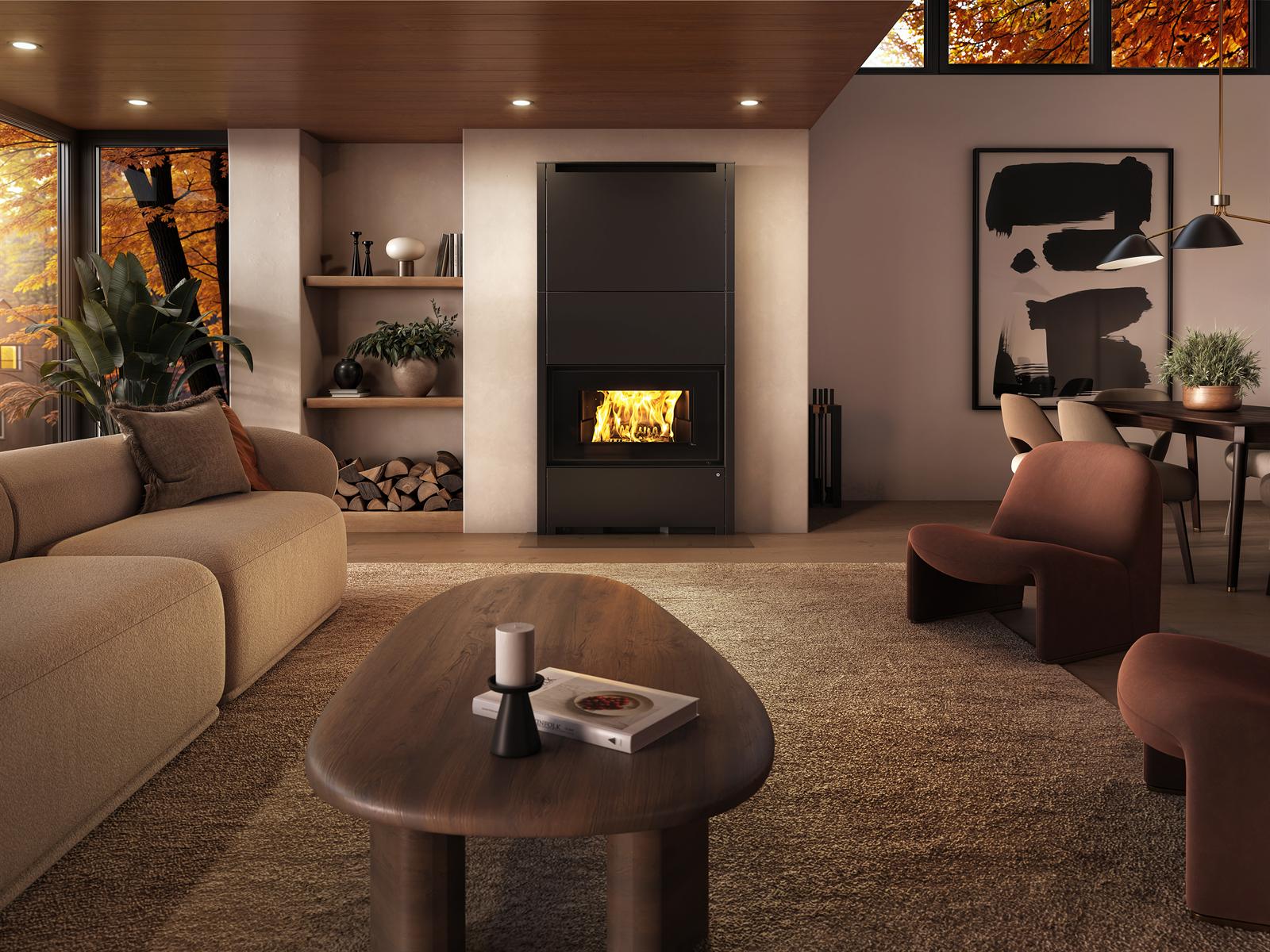
The St-Louis is the newest, and the one that asks least of the person tending it. Valcourt calls its combustion system NexFlame: the fireplace regulates its own air, in a thermostatic mode or a manual one, and can be watched and adjusted from a web application. The firebox holds 3.15 cubic feet behind a single door; Valcourt rates it at up to 100,000 BTU an hour on dry cordwood, with a tested range of 29,457 to 93,725, a burn of up to seven hours, and a heating area of 1,000 to 2,400 square feet. A blower is included. It arrives with a tall faceplate of its own, which Valcourt calls the Signature Profile, and an optional extension carries that line to the ceiling — so the St-Louis is a fireplace that brings a good part of its wall with it.
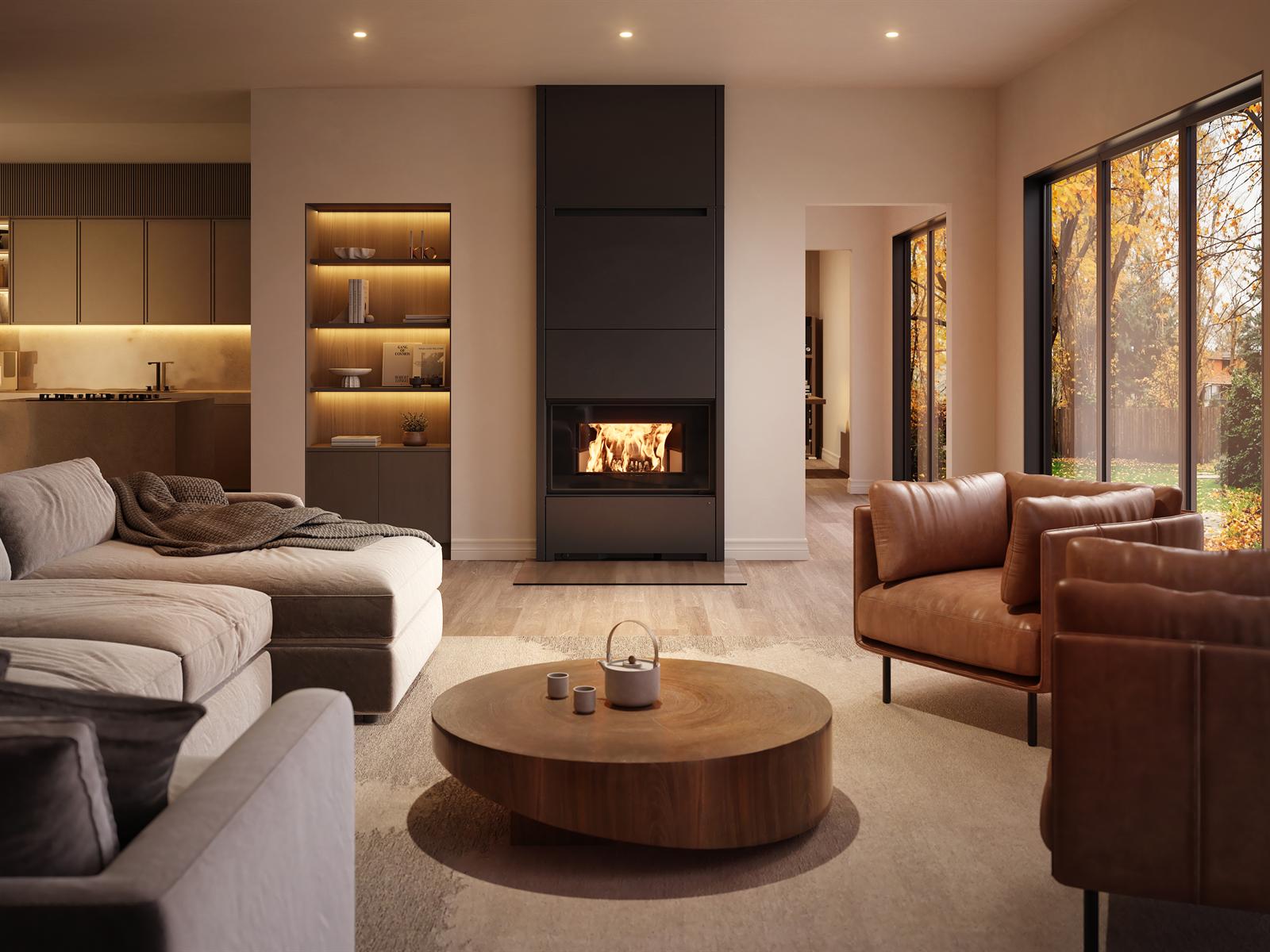
Antoinette
FP7D · Decorative · EPA exempt, not certified · 5.3 cu ft firebox · 8-inch chimney
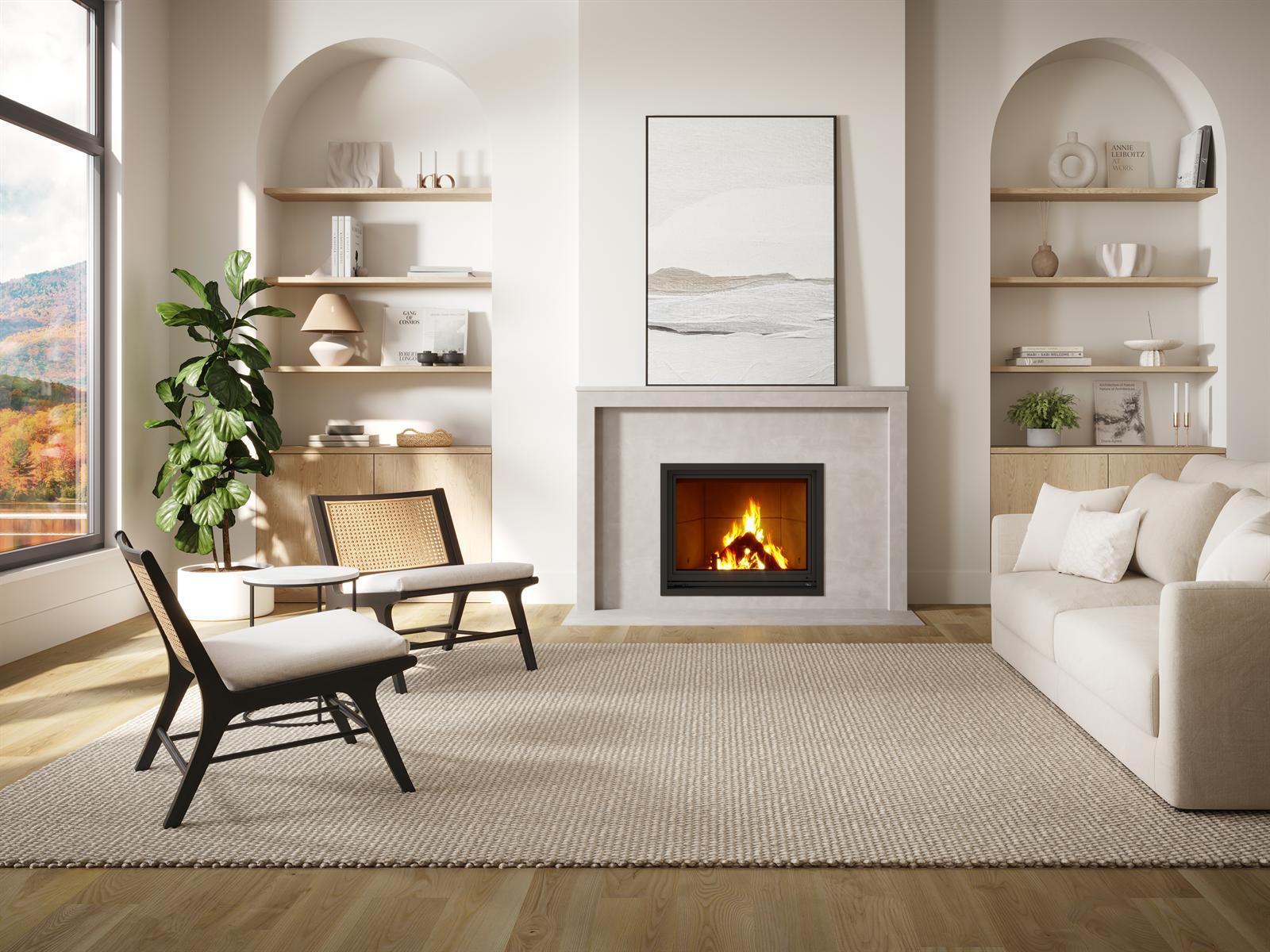
The Antoinette is here for a different reason. It is Valcourt’s guillotine fireplace: the glass door and the firescreen behind it are raised and lowered rather than swung, and both slide down out of sight beneath the hearth, leaving an open fire in a firebox of 5.3 cubic feet. The glass is 29¾ inches wide and 19½ high, and it is Valcourt’s NightFlame ceramic as standard. It is a fireplace for the look and the sound of a fire, and Valcourt says so plainly: its decorative fireplaces have no air control to slow the burn, are not designed to heat a house, and will not hold a fire overnight.
It is also not a certified appliance. Valcourt lists the Antoinette as exempt from the EPA standard, as decorative fireplaces are, and publishes for it a figure of 4.2 grams per kilogram of wood under the EPA’s voluntary fireplace program — a different test and a different unit, which is not a certification and cannot be set beside the grams-an-hour figures above. In Metro Vancouver that matters, because Bylaw 1303 is written around certified appliances. Inside the Urban Containment Boundary a wood fireplace that does not meet the emissions standard can still be registered in two narrow cases: it is the home’s sole source of heat, or it burns nothing but manufactured firelogs, with no visible smoke. Outside the bylaw’s area the rules differ again. We check the address before anything is drawn.
A fireplace is mostly a door — and what the fire is allowed to do behind it.
Seven certified for installation in Metro Vancouver; one to check first. The Lafayette II, Lafayette IIS, Mundo II, Waterloo, Waterloo Arched, Dallaire and St-Louis are certified to the EPA’s 2020 standard, published by Valcourt at 1.2 to 1.9 g/h, and so are eligible to be registered and burned under Metro Vancouver’s Residential Indoor Wood Burning Emission Regulation Bylaw 1303. Inside the Urban Containment Boundary the fireplace must be registered before it is used, the owner files a best-burning-practices declaration renewed every three years, and no wood may be burned from 15 May to 15 September except in homes where it is the only heat; individual municipalities can add requirements of their own. The Antoinette is an EPA-exempt decorative fireplace and is not certified, so whether it can be registered and burned at a given address is a question about the address. We check the address and the model against the bylaw before anything is ordered, and prepare the registration with the permit.
A fireplace framed into a wall is decided by its chimney, which is where the work of Maxwell Fireplace begins: choosing the fire for the room and the face for the house, planning a listed chimney — six inches for the Lafayette II, Mundo II and Dallaire, eight for the Waterloo, St-Louis and Antoinette — that rises at least fifteen feet, deciding at the framing stage whether the heat should travel to another room, setting the hearth and the ember protection in front, pulling the permit and preparing the Bylaw 1303 registration, and installing the fire with our own crew. The stone, plaster or tile around it, and any mantel above, we plan together with the trades doing it — yours, or ones we bring in — to the clearances Valcourt sets. If the house already has a masonry fireplace, the answer is more likely a wood-burning insert.
Images courtesy of Valcourt.
Questions people tend to ask
Are Valcourt fireplaces certified for installation in Metro Vancouver?
Seven of the eight on this page are. The Lafayette II, Lafayette IIS, Mundo II, Waterloo, Waterloo Arched, Dallaire and St-Louis are certified to the EPA’s 2020 standard, which is one of the two standards Metro Vancouver’s Bylaw 1303 accepts, alongside CSA B415.1. Valcourt publishes 1.2 grams of particulate an hour for the Lafayette II and Mundo II, 1.6 for the Waterloo, 1.8 for the St-Louis and 1.9 for the Dallaire. Inside the Urban Containment Boundary the fireplace has to be registered before it is used, and the registration is the homeowner’s to hold; we prepare it with the permit. The Antoinette is not certified.
Can I burn wood in a Valcourt Antoinette in Metro Vancouver?
That depends on the address, and it is the first thing we check. Valcourt lists the Antoinette as a decorative fireplace, exempt from the EPA standard, while Bylaw 1303 is written around appliances certified to CSA B415.1 or the US EPA’s standard. Inside the Urban Containment Boundary a fireplace that does not meet it can still be registered if it is the home’s sole source of heat, or if it burns only manufactured firelogs with no visible smoke; and from 15 May to 15 September no wood may be burned at all, with narrow exceptions. Metro Vancouver decides any particular case. We would rather tell you before the drawings than after the framing.
Which Valcourt suits which room?
By Valcourt’s own heating areas: the Lafayette II, Lafayette IIS and Mundo II for 750 to 2,200 square feet, the Dallaire for 750 to 2,500, the St-Louis for 1,000 to 2,400 and the Waterloo for 1,000 to 2,800. Those are the maker’s ranges, not a promise for a particular house. An oversized fire in a well-sealed home spends its evenings turned down, so we would rather size the fire to the room than to the top of its range, and we confirm it when we measure.
What is the difference between the Lafayette II and the Mundo II?
The face. Both have the same 2.5 cubic foot firebox, the same output of up to 80,000 BTU an hour and the same 1.2 grams an hour. The Lafayette II has an arched faceplate with a louver, or a square one as the Lafayette IIS, and a blower included. The Mundo II has a plain contemporary face with no louvers and sends its warm air through a gravity kit to grilles higher on the wall.
Can the heat reach other rooms?
Yes, on the high-efficiency models. Valcourt makes gravity kits, which let warm air rise through ducts in the wall to grilles above the fireplace, and forced-air kits, which use a fan to carry it to a room further away. Which kits fit which model varies, and on the Mundo II the forced-air kit works only with the modern gravity kit. It is a decision for the framing stage, before the walls are closed.
Does Valcourt make a wood insert or a wood stove?
No. Valcourt’s current range is wood fireplaces built into a framed wall, and nothing else. For an existing masonry fireplace the answer is a wood-burning insert, and for a fire that stands in the room it is a stove; we carry both from other makers, each on a page of its own.
What does an installation need?
A wall framed to Valcourt’s dimensions, a listed chimney of six or eight inches depending on the model that rises at least fifteen feet, non-combustible ember protection on the floor in front, clearances to any mantel and side wall, and a permit. We measure the room, the chimney route and the clearances first, then handle the permit, the Bylaw 1303 registration and the installation with our own crew.