← Back to Wood-Burning Inserts
A Creative FireSpace™ · 10 September 2026
The Morsø 5660 Insert — The Fireplace You Have, in Cast Iron
A Danish cast-iron wood insert for the masonry fireplace you already have — 43,499 BTU for 2,200 square feet, a 20-inch log, tested at 71 percent efficiency, and certified for a wood fire here.

The open masonry fireplace is the one thing in an older house that everyone loves and nobody uses for heat, because it has none to give: lit, it sends the warm air of the room up the chimney faster than it makes any. A great many of the households we work with want to keep it — the stone, the mantel, the place at the centre of the wall — and want it to burn wood, and want it to actually heat the house. That is what a wood-burning insert is for, and the Morsø 5660 is the one we would put in a hearth that deserves it.
Morsø pours it in Nykøbing Mors, on a small island in the north of Denmark, from 98 percent recycled cast iron, and the iron is the point. It holds heat the way stone holds sunlight — warming slowly, then radiating for hours after the last flame has gone — so the insert keeps warming the room while the fire rests. Morsø describes the surface itself with some care: the natural, vivid texture of the cast iron makes for a rustic yet elegant appearance, and the clean lines of its four-sided picture frame are what let a two-hundred-pound piece of foundry work sit quietly in a modern wall as well as an old one.
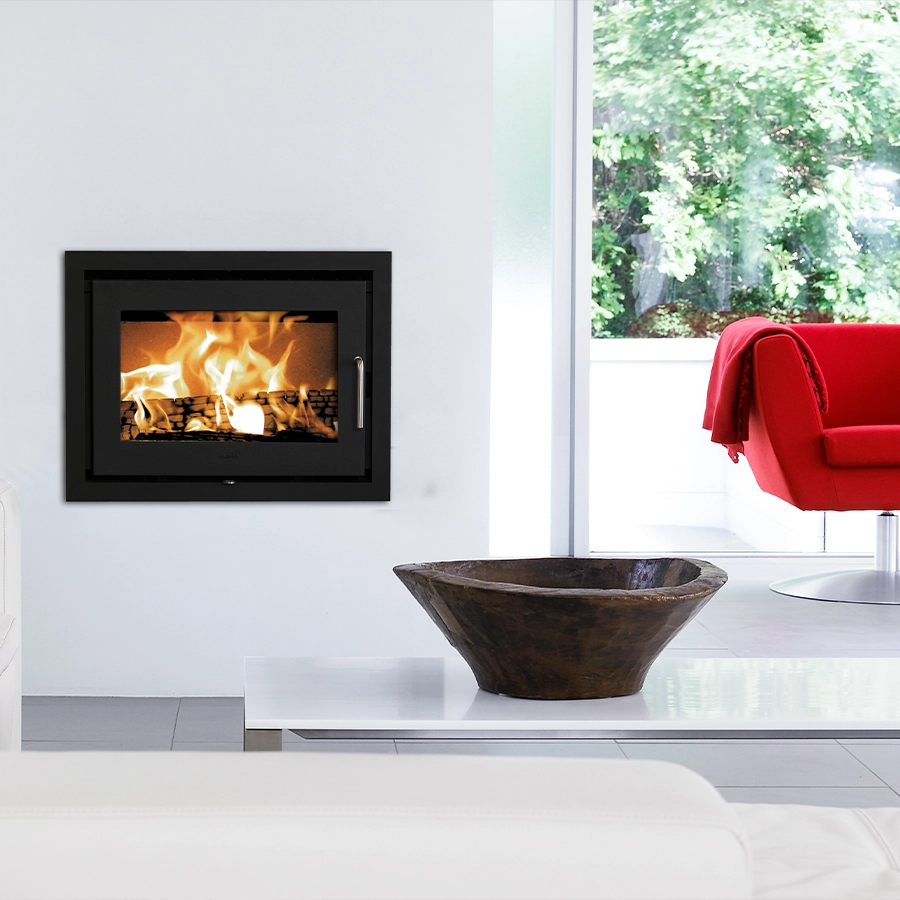
Behind the frame is a single pane of glass, and behind the glass what Morsø calls an unparalleled window of fire: a firebox 20¾ inches wide that takes a 20-inch log, burning on non-catalytic secondary combustion that re-burns its own smoke. Morsø rates it at 43,499 BTU and up to 2,200 square feet — enough, sized rightly, to carry the floor it sits on through most of a winter — with a tested burn of five hours and twenty-nine minutes on a load and a tested efficiency of 71 percent. It vents through a six-inch flue from the top or the rear, can be fed outside air for a tightly built house, and carries the Nordic Swan Ecolabel, one of the strictest environmental marks there is. A three-sided wide trim kit, 40 inches across, closes the larger opening.
Start with the question that stops most wood-burning projects before they begin. The 5660 is EPA 2020 certified, which is the standard Metro Vancouver’s Bylaw 1303 asks for alongside CSA B415.1, at a published 1.55 grams of fine particulate an hour, and it is therefore eligible to be registered and installed in the homes we work in. The registration and the best-burning-practices declaration are the homeowner’s to hold, and we prepare them with the permit. We wrote about Morsø’s freestanding stoves separately; this is the same iron for the household that already has a hearth.
Your surround stays. What changes is the fire inside it.
Certified for installation in Metro Vancouver. The Morsø 5660 B is EPA 2020 certified and eligible to be registered under Metro Vancouver’s Residential Indoor Wood Burning Emission Regulation, Bylaw 1303, with a published particulate figure of 1.55 grams an hour. Inside the Urban Containment Boundary the appliance must be registered before it is used, and the owner files a best-burning-practices declaration renewed every three years; individual municipalities can add requirements of their own. We confirm the model against the bylaw before anything is ordered, and prepare the registration with the permit.
An insert is chosen by three measurements and a chimney. The opening has to be wide, tall and deep enough for the firebox — the 5660 stands about 23 inches high, 28 wide and 17 deep — the flue has to take a liner for its full height and be sound enough to carry it, and the clearances Morsø sets, 17 inches to a side wall and 28½ to a mantel, have to be honoured against the stone or the timber that is already there. That is the work Maxwell Fireplace does in-house: measuring the firebox and inspecting the chimney before we recommend it, pulling the permit and preparing the Bylaw 1303 registration, lining the chimney, and installing the insert with our own crew. Bring us a photograph and the three measurements of the opening, and we will tell you whether it can hold a Morsø.
Questions people tend to ask
Is the Morsø 5660 certified for installation in Metro Vancouver?
Yes. It is EPA 2020 certified, which satisfies Metro Vancouver’s Bylaw 1303, and Morsø publishes its particulate figure at 1.55 grams an hour. Inside the Urban Containment Boundary it must be registered before it is used, and the owner files a best-burning-practices declaration renewed every three years. We confirm the model against the bylaw before it is ordered and prepare the registration with the permit.
Will it fit the fireplace I already have?
Often, and the measuring is where we start. The insert stands about 23 inches high, 28 wide and 17 deep, and its cast frame closes the rest of the opening; for a wider hearth Morsø makes a three-sided trim kit 40 inches across. Morsø also sets clearances of 17 inches to a side wall and 28½ to a mantel, which the existing stone or timber has to respect. We measure the width, height and depth of the opening and the state of the chimney before we say yes.
Will it actually heat the house?
It will. Morsø rates the 5660 at 43,499 BTU and up to 2,200 square feet, with a tested efficiency of 71 percent and a tested burn of five and a half hours on a single load, and the cast iron goes on radiating after the flames have dropped. An open fireplace cools a house; this is the same hearth turned into its main source of heat.
How does it vent?
Through the chimney you already have, with a six-inch stainless liner run to the top for its full height. The insert takes the flue from the top or the rear, and can be fed combustion air from outside for a tightly built house, so it draws on none of the room’s air. The chimney has to be sound enough to carry the liner, which is one of the things we inspect before recommending it.
How long a log does it take?
Twenty inches, in a firebox 20¾ inches wide and 11 deep with a capacity of 1.15 cubic feet — a full-size log, split and seasoned, rather than the short pieces a small stove asks for. Burn dry wood and it will reward you with a long, clean, even fire.
Should I choose a wood insert or a gas one?
It depends on what you want from the fireplace. The Morsø gives you a real wood fire, the smell and the sound of it, and heat that owes nothing to the utility, at the cost of wood to store and a chimney to sweep. A gas insert lights from a remote and needs neither; we wrote about Enviro’s separately. Both retrofit into the same masonry opening, so the fireplace itself rarely decides it.
Where is it made, and where can I see one in Vancouver?
It is poured by Morsø in Nykøbing Mors, Denmark, from 98 percent recycled cast iron. Come to Maxwell Fireplace in North Vancouver and we will walk you through the insert, the trim kits and the freestanding Morsø stoves beside it, and take the three measurements that decide whether your fireplace can hold it. We serve the North Shore, Vancouver and the Sea to Sky corridor.