← Back to Wood-Burning Stoves & Fireplaces
A Creative FireSpace™ · 18 November 2026
Pacific Energy FP25 & FP30 — A Wood Fire Built Into the Wall
Two zero-clearance wood fireplaces from British Columbia, each made square or arched, for a room that has no fireplace yet and would like a real one — with the certification stated on the page.
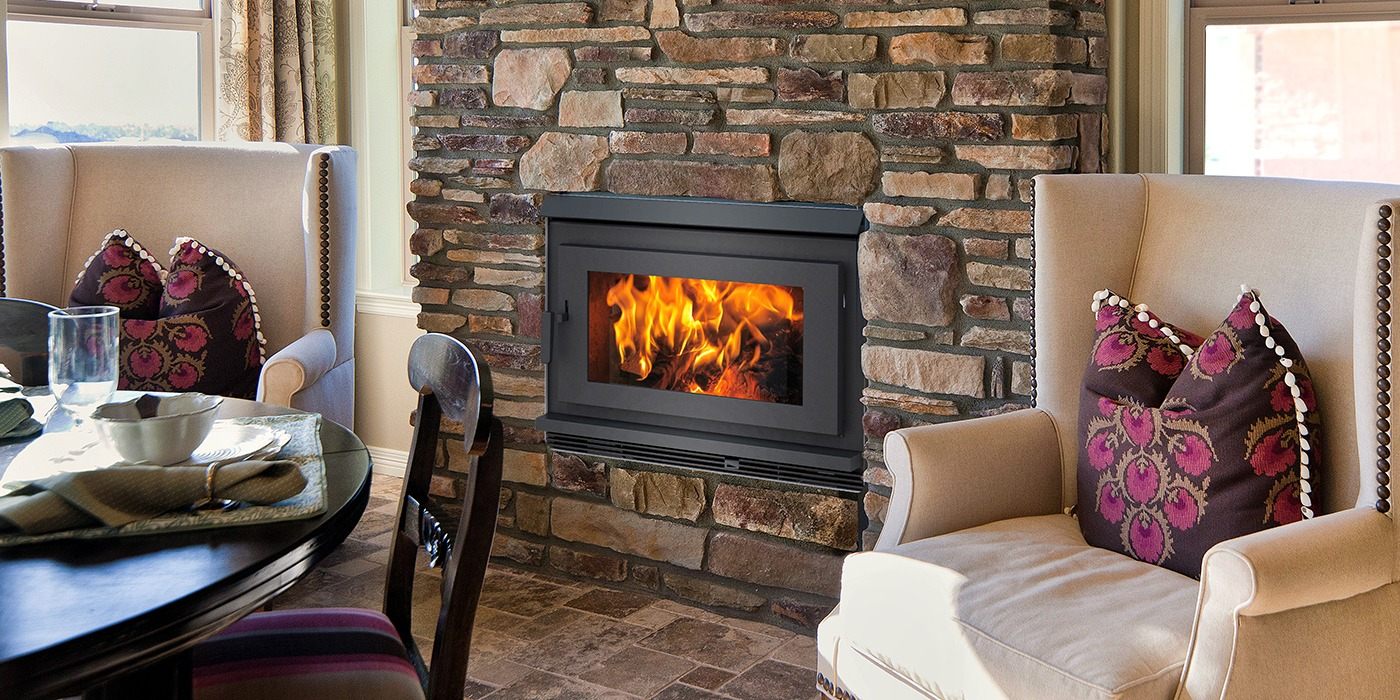
Some houses were built without a fireplace, and some were built with one that was taken out. For either, the answer used to be a stove on a hearth in the corner of the room. A zero-clearance fireplace is the other answer: a sealed, certified wood firebox inside a steel casing that can be framed straight into a wood-stud wall, with nothing between the casing’s standoffs and the framing, vented through a listed chimney and finished like any other part of the wall. The fire sits where a fireplace ought to sit, and the room keeps its floor.
Pacific Energy builds the FP25 and the FP30 in Duncan, British Columbia, in the same way it builds its inserts. There is no catalytic element to clog and replace. Preheated air is fed through a tube above the fire and the smoke burns a second time before it reaches the chimney; on the FP25, Pacific Energy lists a 304 stainless baffle and a firebox that floats on its frame, so that heating and cooling do not stress the welds. An airwash keeps the glass clear, a single control sets the air, and a boost of air at the start makes the fire easy to light. Two temperature-switched blowers move the warmth into the room once the fire has built.
Begin with the question that ends most wood-fire projects before they start. Both fireplaces are certified to the EPA’s 2020 standard, which is one of the two standards Metro Vancouver’s Bylaw 1303 accepts, alongside CSA B415.1. Pacific Energy’s manuals give the FP25 a tested 1.4 grams of particulate an hour and the FP30 1.7, tested on cordwood. That makes each one eligible to be registered and burned inside the Urban Containment Boundary. The registration, and the best-burning-practices declaration that goes with it, are the homeowner’s to hold; we prepare them with the permit.
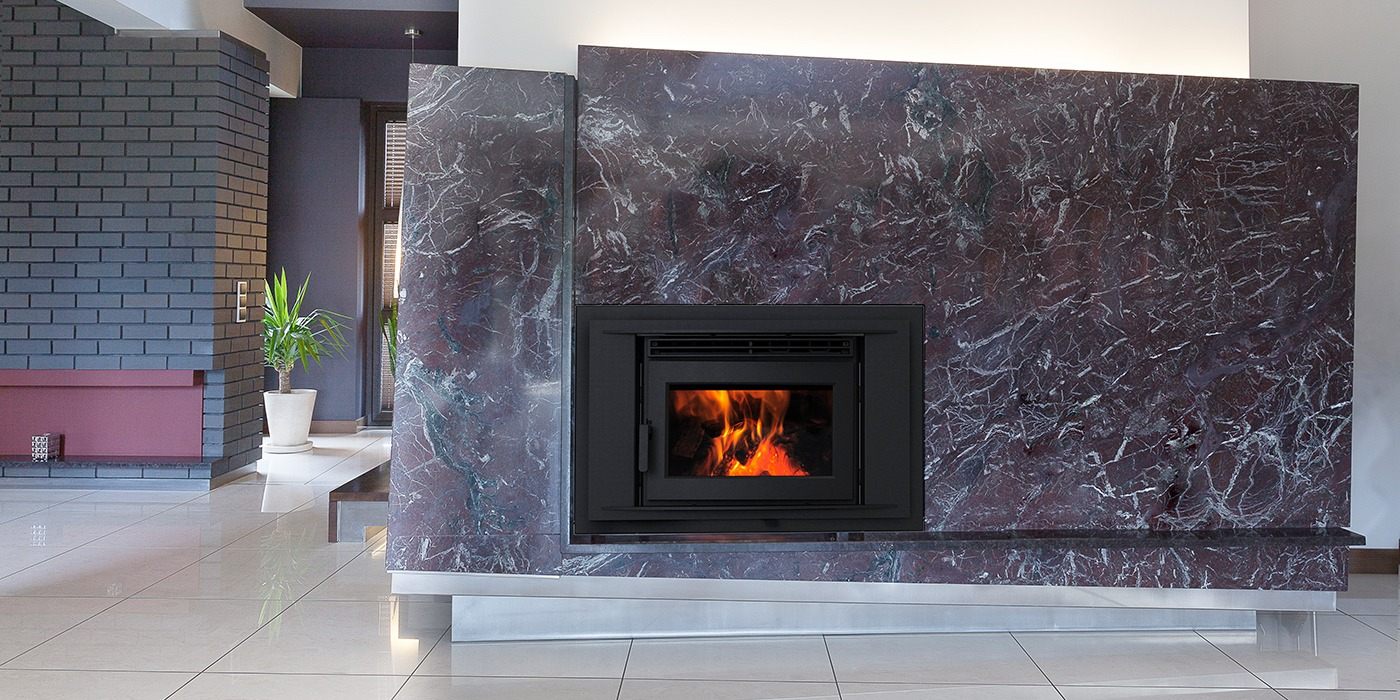
The FP25 is the one for most living rooms. Its firebox holds 2.1 cubic feet and takes logs loaded side to side, 16 inches ideally and 17 at most, behind 165 square inches of glass. On the EPA’s test it gives between 11,000 and 51,500 BTU an hour, and Pacific Energy rates it at 72,000 on cordwood. It weighs 610 pounds, which the floor and the framing need to know before the first drawing is made.
The FP30 is the one for the large room, and for the household that would rather load the fire less often. The firebox grows to 3.0 cubic feet and turns ninety degrees, so the logs go in front to back, 18 inches ideally and 20 at most, and the glass grows to 246 square inches. The EPA range is 13,700 to 65,650 BTU an hour, and Pacific Energy rates it at 99,000 on cordwood. It weighs 626 pounds. More fire is not always better: an oversized fire in a well-sealed house spends its evenings turned down and smouldering, so we would rather size the fire to the room than to the top of its range.
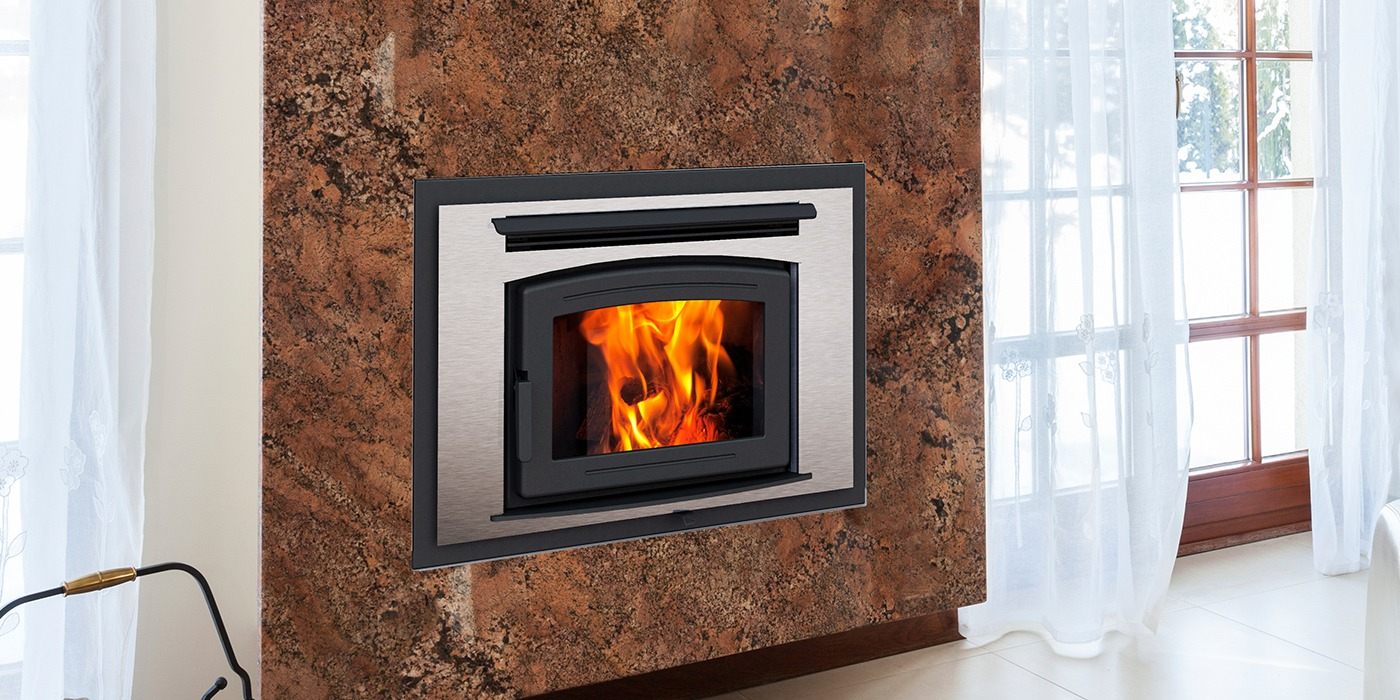
Each comes in two faces, and the choice is the house’s more than the fire’s. The LE has a square cast-iron door, the clean line for a contemporary wall of stone, plaster or tile. The Arch LE curves the top of the door, the line for a room with a mantel and a history; on the FP25 Arch the glass is a little smaller, at 160 square inches, and on the FP30 Arch the door is framed in curved cast iron. Pacific Energy shows the FP25’s surround trim in metallic black or stainless steel, and offers a Craftsman surround for the FP30 Arch alone.
The heat need not stay in one room. Pacific Energy makes a remote heat kit for these fireplaces that draws warm air from the casing through 6-inch B-vent to another room, or two, each on a switch of its own; it brings a blower of its own and needs a 120-volt supply. It is a decision for the framing stage, not after the drywall.
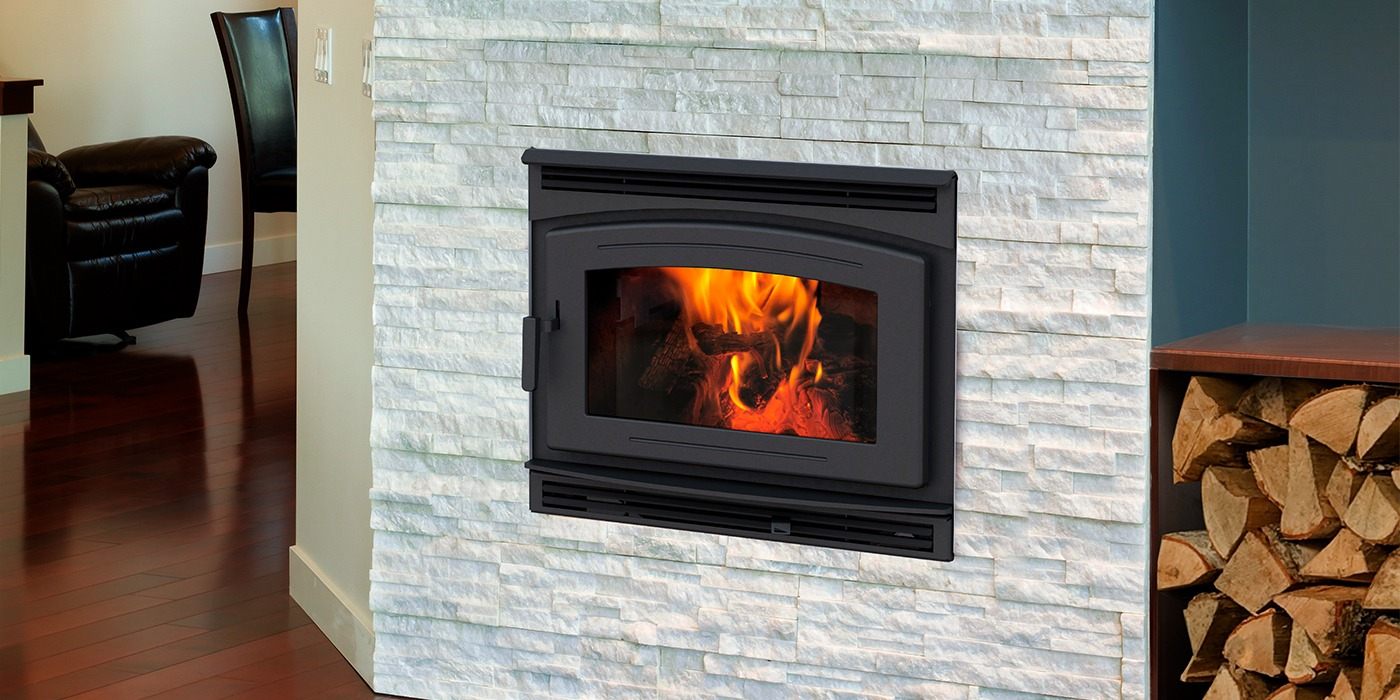
The fireplace the house was never given, built into the wall where it belongs.
Certified for installation in Metro Vancouver. The FP25 LE, FP25 Arch LE, FP30 LE and FP30 Arch LE are all certified to the EPA’s 2020 standard, published at 1.4 g/h for the FP25 and 1.7 g/h for the FP30, and so are eligible to be registered and burned under Metro Vancouver’s Residential Indoor Wood Burning Emission Regulation Bylaw 1303. Inside the Urban Containment Boundary the fireplace must be registered before it is used, the owner files a best-burning-practices declaration renewed every three years, and no wood may be burned from 15 May to 15 September except in homes where it is the only heat; individual municipalities can add requirements of their own. We check the address and the model against the bylaw before anything is ordered, and prepare the registration with the permit.
A fireplace framed into a wall is decided by its chimney, which is where the work of Maxwell Fireplace begins: choosing the size for the room and the door for the house, planning a 6-inch listed chimney that rises at least fifteen feet from the base of the fireplace, bringing in combustion air from outside through a 4-inch duct, setting the steel framing kit, the hearth and the ember protection in front, pulling the permit and preparing the Bylaw 1303 registration, and installing the fire with our own crew. The stone, plaster or tile around it, and any mantel above, we plan together with the trades doing it — yours, or ones we bring in — to the clearances Pacific Energy sets. If the house already has a masonry fireplace, the answer is more likely one of Pacific Energy’s inserts.
Images courtesy of Pacific Energy.
Questions people tend to ask
Are the Pacific Energy FP25 and FP30 certified for installation in Metro Vancouver?
Yes. All four versions, the FP25 LE, FP25 Arch LE, FP30 LE and FP30 Arch LE, are certified to the EPA’s 2020 standard, which is one of the two standards Metro Vancouver’s Bylaw 1303 accepts, alongside CSA B415.1. Pacific Energy publishes 1.4 grams of particulate an hour for the FP25 and 1.7 for the FP30, tested on cordwood. Inside the Urban Containment Boundary the fireplace has to be registered before it is used, and the registration is the homeowner’s to hold; we prepare it with the permit.
What is the difference between the FP25 and the FP30?
Size, and the way the wood goes in. The FP25 has a 2.1 cubic foot firebox loaded side to side with logs up to 17 inches, 165 square inches of glass, and an EPA range of 11,000 to 51,500 BTU an hour (72,000 on cordwood by Pacific Energy’s rating). The FP30 has 3.0 cubic feet loaded front to back with logs up to 20 inches, 246 square inches of glass, and 13,700 to 65,650 BTU an hour (99,000 on cordwood). Pacific Energy suggests the FP25 for medium to large rooms and the FP30 for large ones.
What is the difference between the LE and the Arch LE?
The face. The LE has a square cast-iron door; the Arch LE has an arched one, with slightly less glass on the FP25 Arch and a curved cast-iron frame on the FP30 Arch. The firebox, the output and the certification are the same within each size. Pacific Energy’s Craftsman surround is made for the FP30 Arch only.
What does an installation need?
A wall framed to Pacific Energy’s dimensions around the steel framing kit, a 6-inch chimney listed to ULC S629 that rises at least fifteen feet from the base of the fireplace, outside combustion air through a 4-inch duct where the code or the house calls for it, non-combustible ember protection on the floor in front, clearances to any mantel and side wall, and a permit. We measure the room, the chimney route and the clearances first, then handle the permit, the Bylaw 1303 registration and the installation with our own crew.
Can the heat reach other rooms?
Yes, with Pacific Energy’s optional remote heat kit, which ducts warm air from the fireplace casing through 6-inch B-vent to another room, each duct on its own switch. The kit has its own blower and needs a 120-volt supply, and it is planned at the framing stage, before the walls are closed.
Can I burn it with the door open?
No. Pacific Energy’s manuals say plainly that these fireplaces are not designed to be run with the door open: sparks can reach the room, and an open door draws air out of the house. The glass is the view, and the airwash is there to keep it clear.