← Back to Wood-Burning Stoves & Fireplaces
A Creative FireSpace™ · 23 November 2026
Pacific Energy NeoView — The Wood Stove, Made to Order
A modular wood stove from British Columbia: two fireboxes, four bases and eight finishes, put together for the room it is going into — with the certification stated on the page.
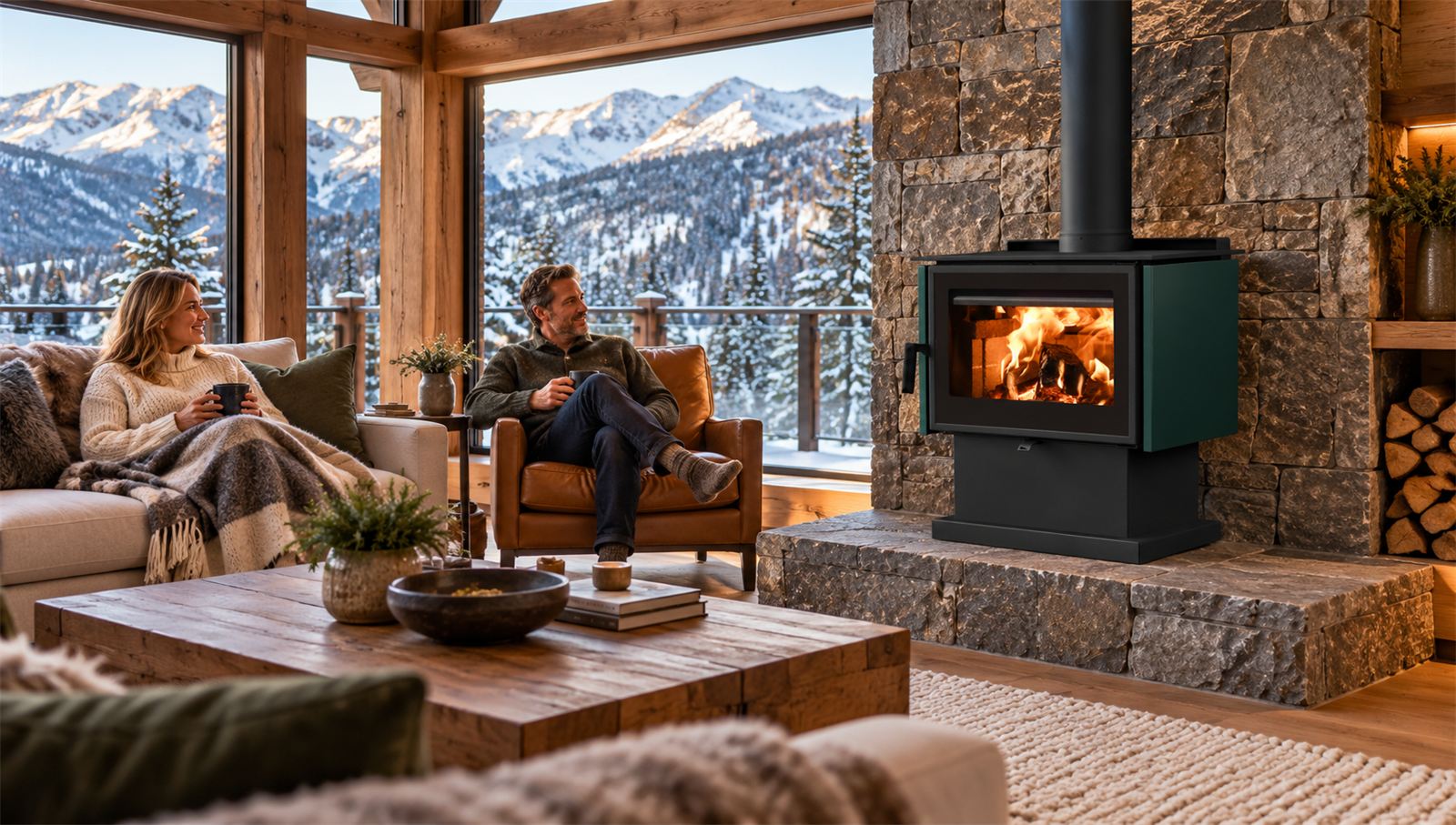
A wood stove has usually been bought the way it left the factory: one body, one set of legs, black. The NeoView is built the other way round. You choose the firebox for the house, then what it stands on, then the colour of its sides, and Pacific Energy assembles the stove from those three decisions. The result is a wide, low, Euro-inspired stove with a generous pane of glass, and it can look like a piece of mid-century furniture on four legs or a quiet block of enamel on a pedestal, according to the room.
Pacific Energy builds the NeoView in Canada around the fireboxes of its Neo stoves, and in the same way it builds everything else. There is no catalytic element to clog and replace. The baffle, the air tubes, the rails and the flame shield are 304 stainless steel, a boost of air at the start makes the fire easy to light, and what Pacific Energy calls its Extended Burn Technology stretches a load of wood through the night. The logs go in side to side, parallel to the glass, so the fire is seen along its length. A temperature-actuated, variable-speed blower is the one performance option.
Begin with the question that ends most wood-fire projects before they start. Both sizes, the NeoView 1.6 LE2 and the NeoView 2.5 LE2, are certified to the EPA’s 2020 standard, which is one of the two standards Metro Vancouver’s Bylaw 1303 accepts, alongside CSA B415.1. Pacific Energy’s manuals give each a certified 1.6 grams of particulate an hour. That makes either one eligible to be registered and burned inside the Urban Containment Boundary. The registration, and the best-burning-practices declaration that goes with it, are the homeowner’s to hold; we prepare them with the permit.
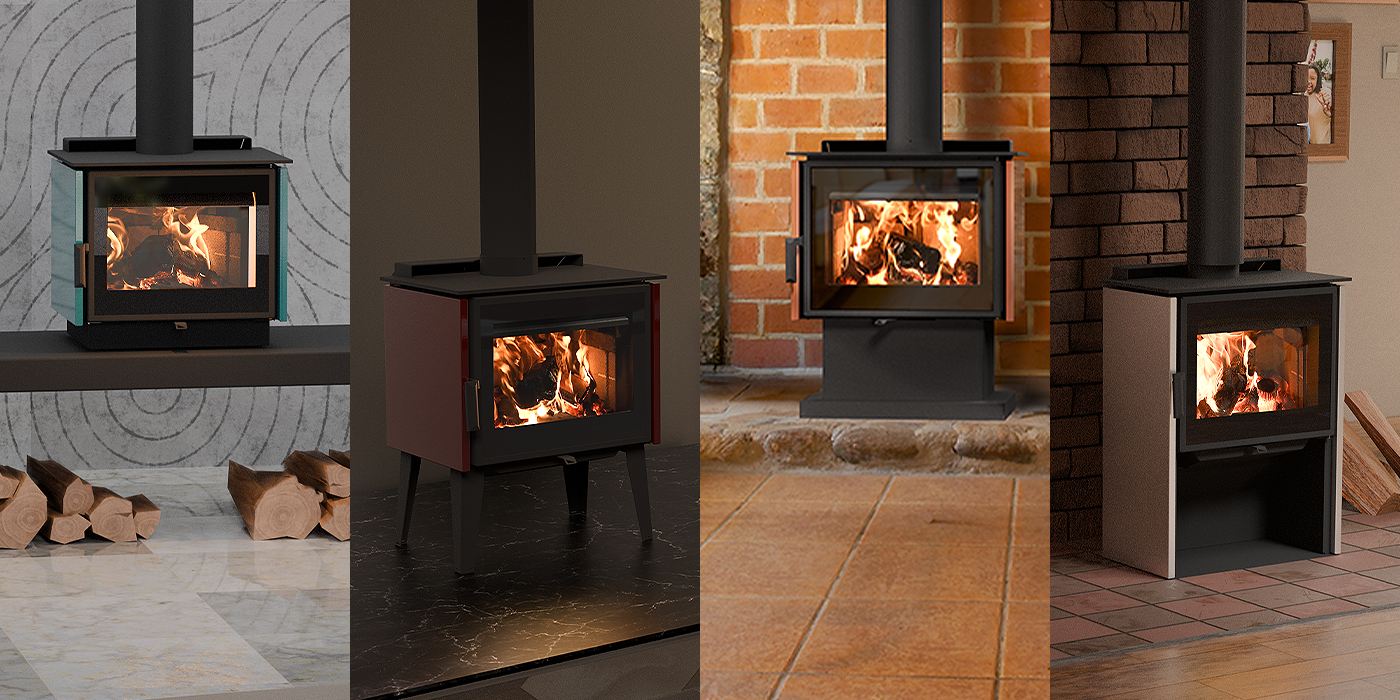
The NeoView 1.6 LE2 is the smaller fire. Its firebox holds 1.4 cubic feet and takes logs of 17 inches ideally and 18 at most, and Pacific Energy rates it at a peak of 54,000 BTU an hour on cordwood. Pacific Energy suggests it for smaller homes and cabins, for moderate climates, and for a stove that supplements another source of heat — which describes a good many of the rooms we are asked about.
The NeoView 2.5 LE2 is the larger one, for a bigger house, an open plan, or a stove that is expected to do most of the heating. The firebox is 1.9 cubic feet, the logs are the same 17 and 18 inches, and the peak rises to 85,000 BTU an hour on cordwood. More fire is not always better: an oversized stove in a well-sealed house spends its evenings turned down and smouldering, so we would rather size the fire to the room than to the top of its range.
One thing about the LE2 is worth knowing before the stove is placed. It carries a small control board at the back, with a sensor in the flue, fed by a plug-in adapter, so it wants a wall outlet within reach. Pacific Energy offers a battery box for it, and its manual says that with no power at all the stove still runs within its safe and certified limits on the hand air control at the front — so the fire does not depend on the grid on the night the grid is down.
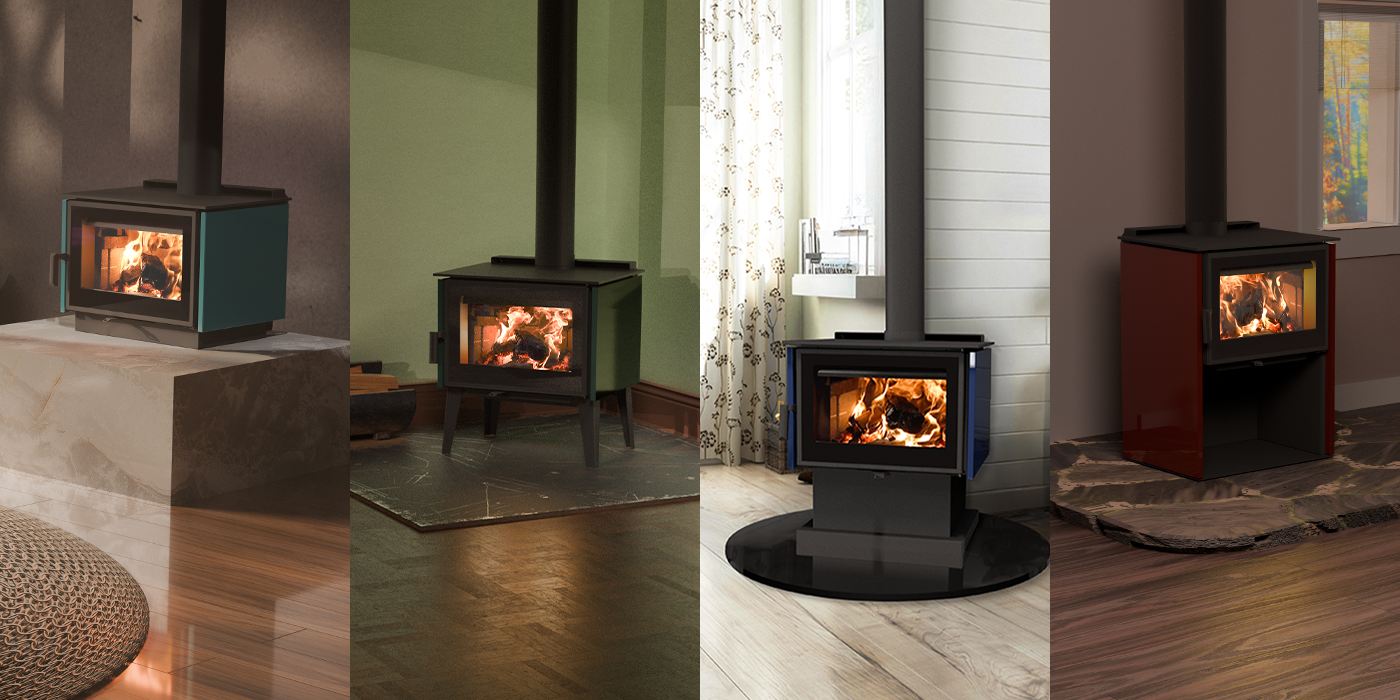
Then the base, of which there are four. On legs it is a wood stove in the familiar sense, with the floor visible beneath it. The pedestal closes that space into a clean column. The wood box turns it into a place to keep the evening’s logs, under the fire. The short base sets the stove low, and is made to sit on a raised masonry hearth rather than the floor. The sides come in porcelain enamel — Sunset Red, Modern Desert, Evergreen, Pacific Teal, Midnight Blue, Ivory or Black — or painted Metallic Black.
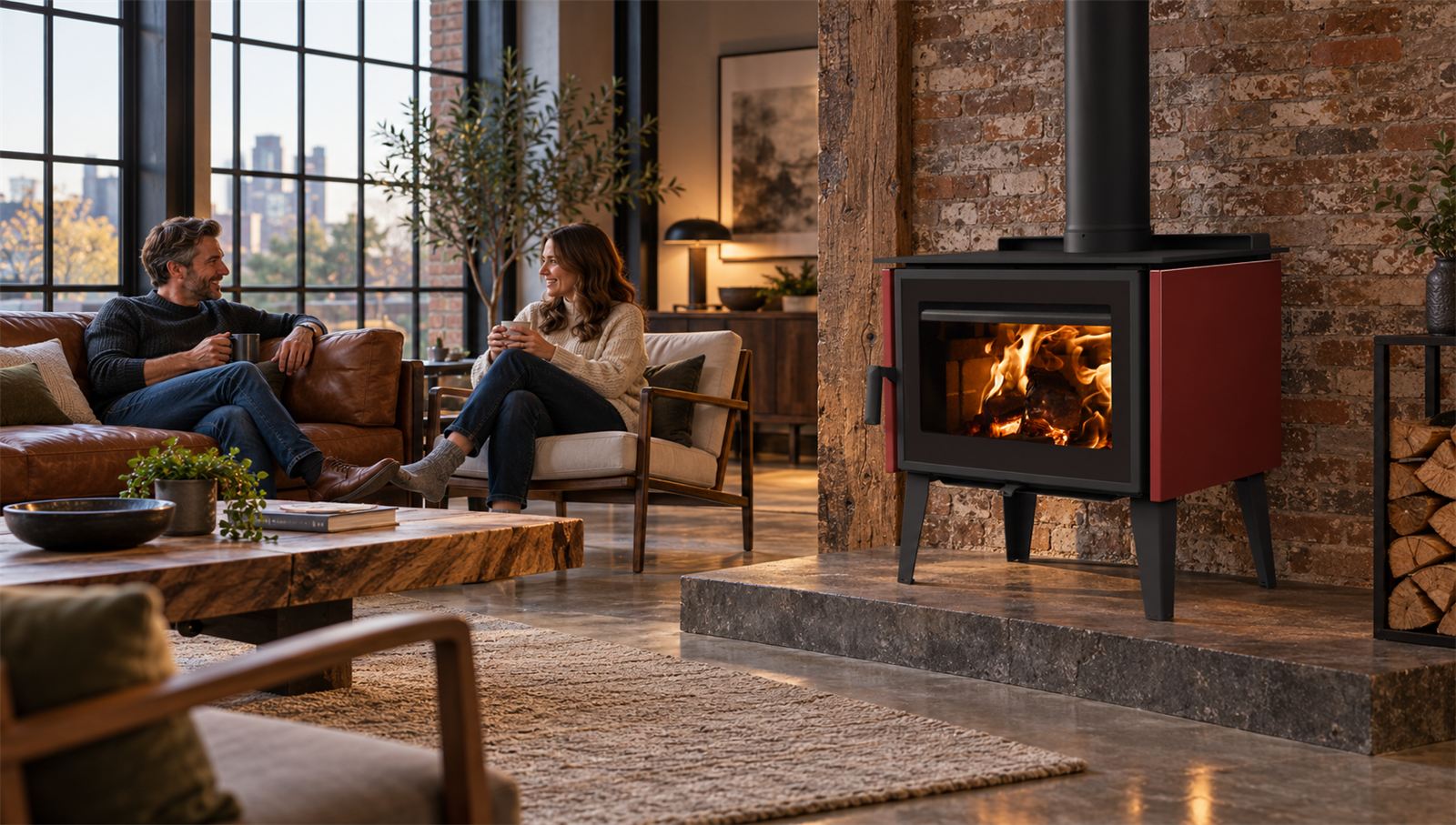
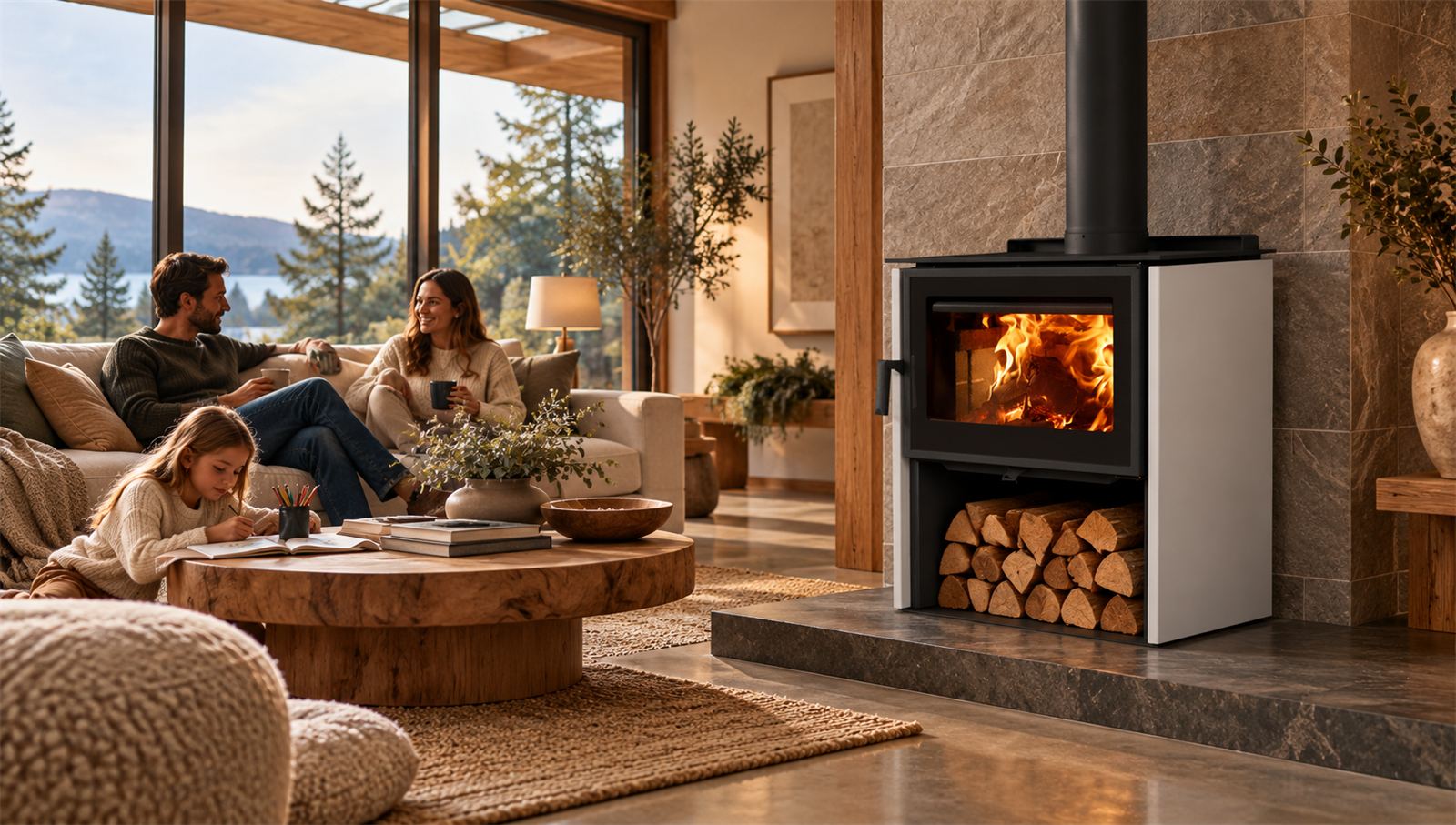
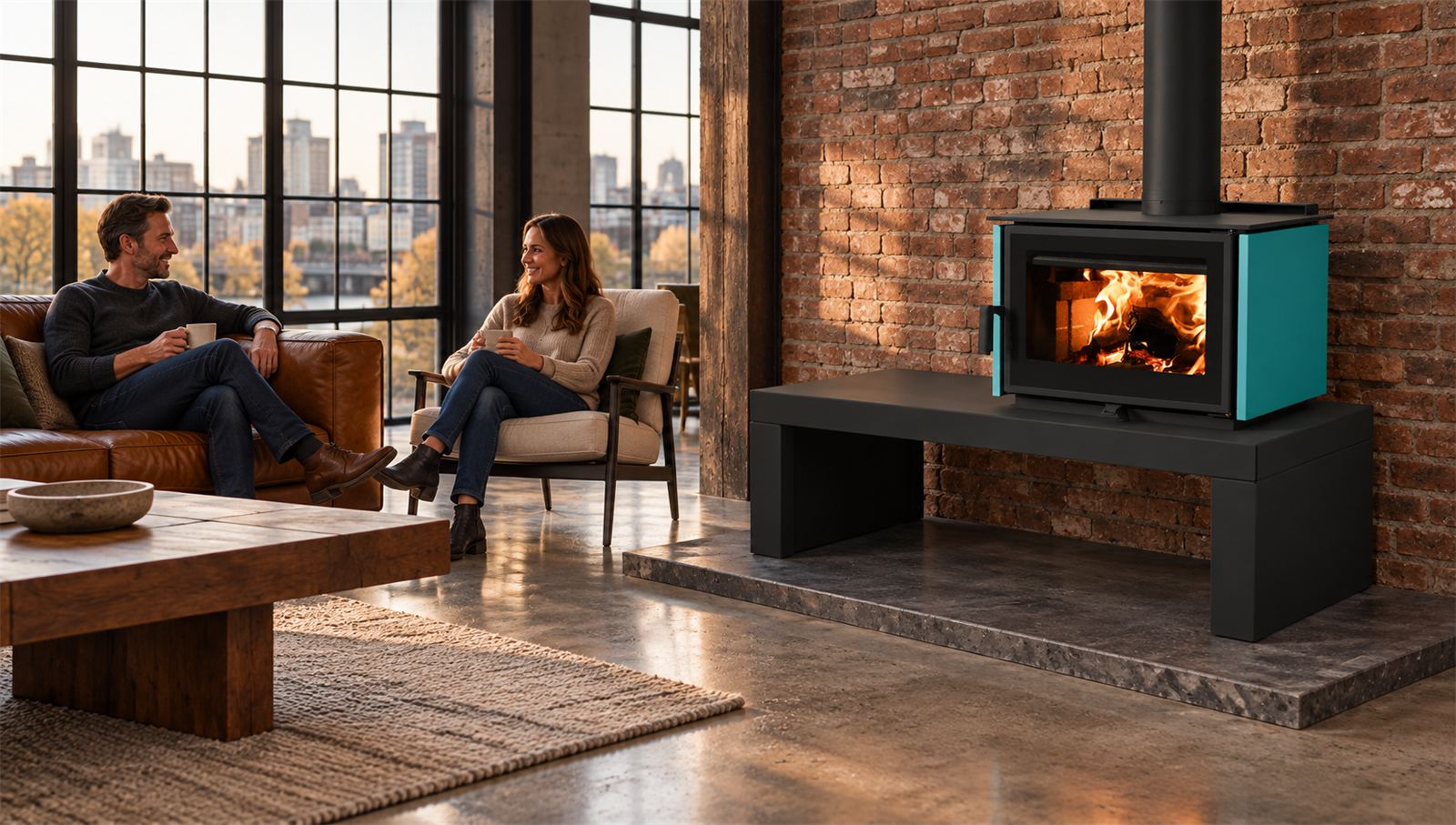
Choose the fire first, then what it stands on, then the colour it wears.
Certified for installation in Metro Vancouver. The NeoView 1.6 LE2 and 2.5 LE2 are both certified to the EPA’s 2020 standard, published at 1.6 g/h each, and so are eligible to be registered and burned under Metro Vancouver’s Residential Indoor Wood Burning Emission Regulation Bylaw 1303. Inside the Urban Containment Boundary the stove must be registered before it is used, the owner files a best-burning-practices declaration renewed every three years, and no wood may be burned from 15 May to 15 September except in homes where it is the only heat; individual municipalities can add requirements of their own. We check the address and the model against the bylaw before anything is ordered, and prepare the registration with the permit.
A freestanding stove looks like the simplest fire to add to a house, and it is the one most often placed badly. That is where the work of Maxwell Fireplace begins: choosing the size for the room and the base for the floor, setting the stove to Pacific Energy’s clearances from the walls behind and beside it, planning a 6-inch connector and a listed chimney that rises at least fifteen feet from the base of the stove, laying the ember protection in front, bringing in outside air where the house calls for it, pulling the permit and preparing the Bylaw 1303 registration, and installing it with our own crew. A hearth or a wall of stone or tile behind the stove we plan together with the trades doing it — yours, or ones we bring in. If the house already has a masonry fireplace, the answer is more likely one of Pacific Energy’s inserts, two of which come from the same Neo family; if the fire is to be framed into a wall, it is the FP25 or FP30.
Images courtesy of Pacific Energy.
Questions people tend to ask
Are the Pacific Energy NeoView stoves certified for installation in Metro Vancouver?
Yes. The NeoView 1.6 LE2 and the NeoView 2.5 LE2 are both certified to the EPA’s 2020 standard, which is one of the two standards Metro Vancouver’s Bylaw 1303 accepts, alongside CSA B415.1. Pacific Energy’s manuals give each a certified 1.6 grams of particulate an hour. Inside the Urban Containment Boundary the stove has to be registered before it is used, and the registration is the homeowner’s to hold; we prepare it with the permit.
Should I choose the NeoView 1.6 LE2 or the 2.5 LE2?
By the room, not by ambition. The 1.6 has a 1.4 cubic foot firebox and a peak of 54,000 BTU an hour on cordwood by Pacific Energy’s rating, and Pacific Energy suggests it for smaller homes, cabins and supplemental heat. The 2.5 has a 1.9 cubic foot firebox and a peak of 85,000 BTU an hour, for larger homes, open plans and primary heating. Both take logs of 17 inches ideally and 18 at most. Pacific Energy’s approximate maximum burn times are 7 to 10 hours for the 1.6 and 8 to 12 for the 2.5.
Which base should I choose, and what can it stand on?
There are four: legs, a pedestal, a wood box and a short base. On legs, the pedestal or the wood box, Pacific Energy’s manuals allow the stove on a combustible floor, provided non-combustible ember protection is laid beneath and in front of it. The short base is different: it may only sit on a masonry hearth, or one built of steel studs with a top at least an inch thick, raised at least 11 inches above the floor. The stove must be installed on one of the four; it cannot stand without a base.
Does the NeoView need electricity?
A little. The NeoView LE2 has a control board that plugs into a wall outlet through a small adapter. Pacific Energy offers an optional battery box, which it estimates will last five to seven days of continuous use, and its manual says that in a complete power failure the stove still operates within safe and certified limits on the manual air control. The optional blower needs a 115-volt outlet as well.
What does an installation need?
Clearances to the walls as Pacific Energy sets them, a 6-inch connector into a chimney listed to ULC S629, a system at least fifteen feet tall measured from the base of the stove, non-combustible ember protection extending 18 inches in front of the door and 8 inches to the other sides, outside combustion air through a 4-inch duct where the code or the house calls for it, and a permit. We measure the room and the chimney route first, then handle the permit, the Bylaw 1303 registration and the installation with our own crew.
Can a NeoView be put into an existing fireplace?
No. Pacific Energy lists the NeoView as a freestanding room heater and its label says it is not to be installed in any fireplace. For a masonry fireplace the answer is a wood insert, and Pacific Energy’s Neo 1.6 and Neo 2.5 inserts come from the same family; they are on our Pacific Energy wood inserts page.