← Back to Wood-Burning Stoves & Fireplaces
A Creative FireSpace™ · 25 August 2026
Stûv 6-H Wood Stove — The Essential Stove
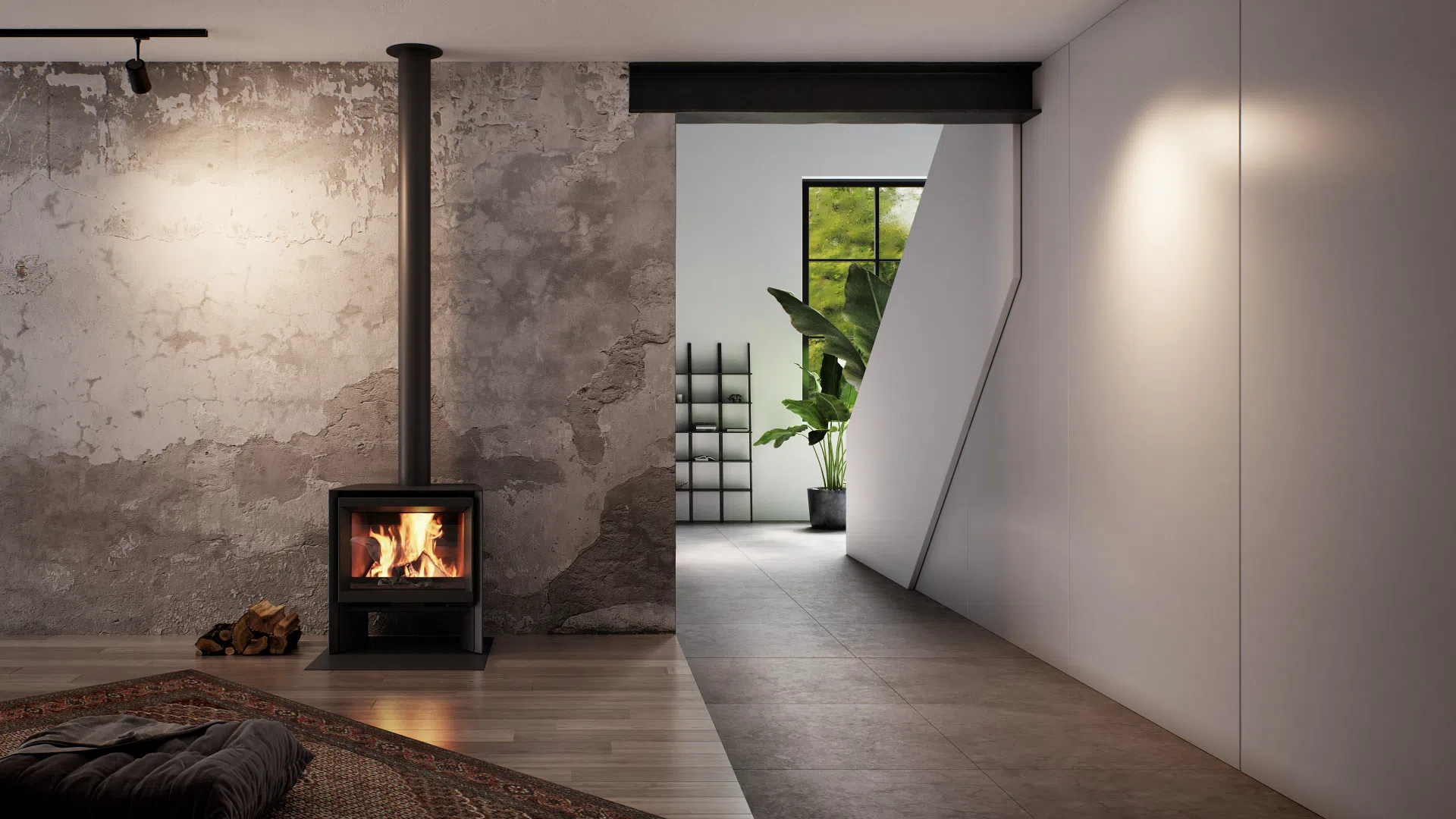
There is a particular confidence in a maker who, after four decades of pivoting fireboxes and see-through hearths and cladding that can read as rough stone in one house and gallery-white in the next, sits down and builds a plain stove. Stûv have been at this since 1983. We have carried their work since 2014 — long enough to know that when they call something the essential stove, they are not apologising for it. They mean that everything which wasn’t essential has been taken out.
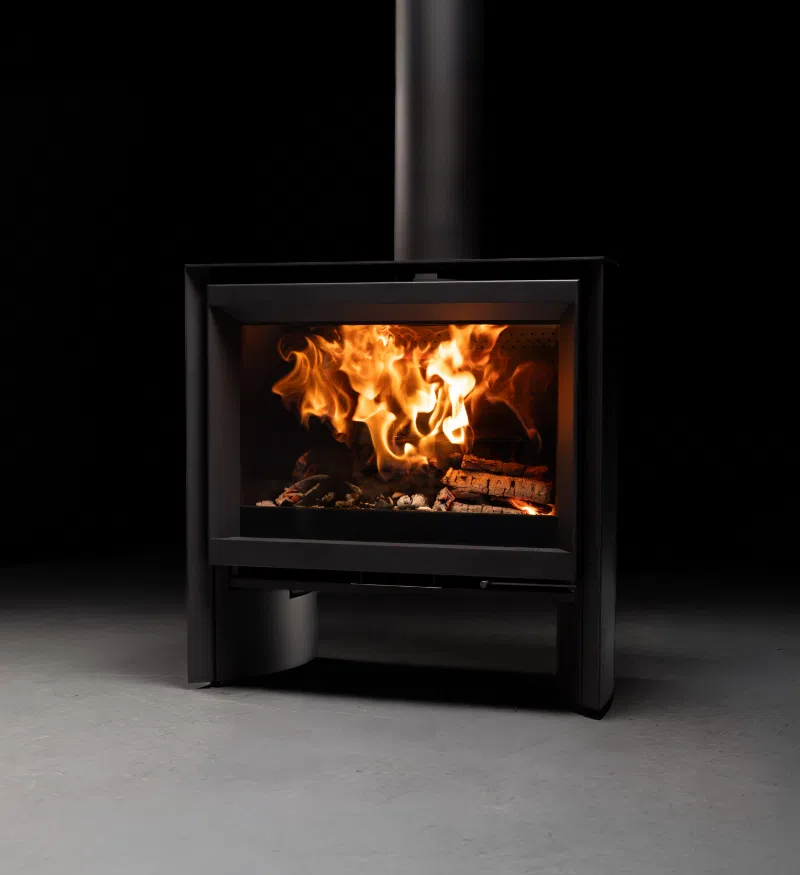
The 6-H is what’s left. A small black stove standing on its own legs, a wide window of fire at its middle, and just enough softness in the edges to keep it from being severe. Two hundred and thirty pounds, most of it cast iron and steel where it matters. And like every Stûv sold in North America, it is designed in Belgium and built in Quebec — engineered to our codes and our winters, with parts that never have to cross an ocean to reach you.
The part worth standing in front of is the firebox, and the reason is easy to miss until someone points at it.
Most fireboxes are boxes. This one is patented, and it is a wedge: narrower at the back, widening steadily toward the door frame. You can see it in the shoulder of the stove — the body tapers away from you. What that shape does is bring the fire forward. Instead of a deep fire receding into a dark cavity, you get a broad one, pressed up against the glass and spread across the full width of the opening — a small stove giving you a wide view of the flame rather than a long one. The chamber is cast iron, and its interior is black, so the fire has something to be bright against.
Then there is the air, which is where most wood stoves are either clever or tiresome. Stûv made the 6-H clever. Two metal plates sit at the base of the combustion chamber, and because they expand at different rates as the stove comes up to temperature, that difference becomes the mechanism — the stove reads its own heat and adjusts its own air supply, continuously, right through the burn. Stûv call it SBR. What it means in a room is that nobody has to kneel in front of it with a lever, guessing. It is a wood fire that takes fewer decisions to burn well.
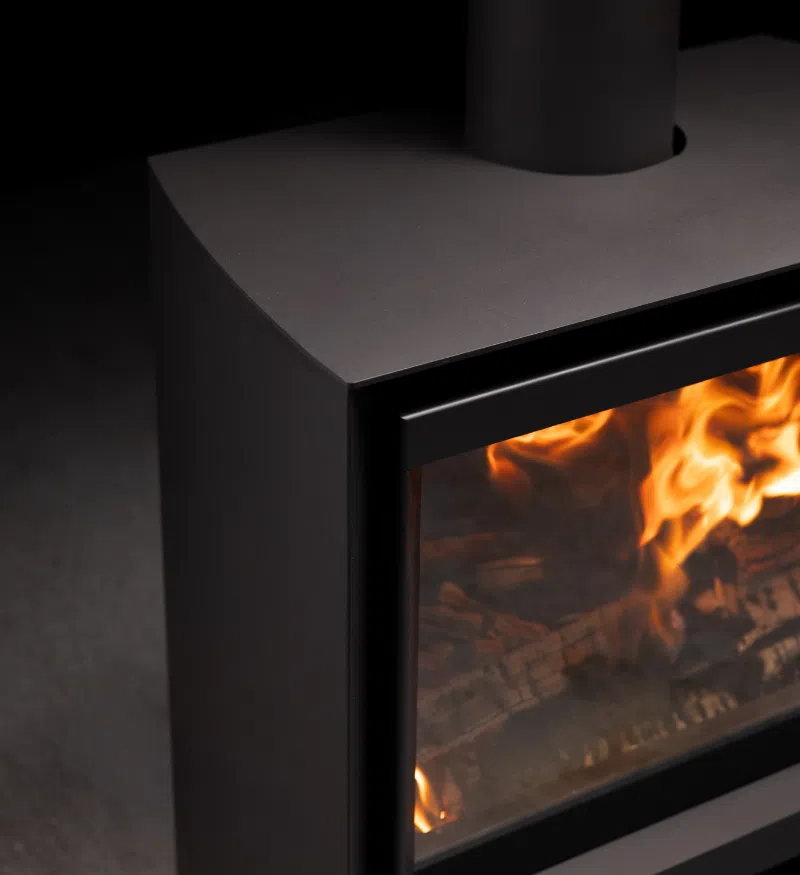
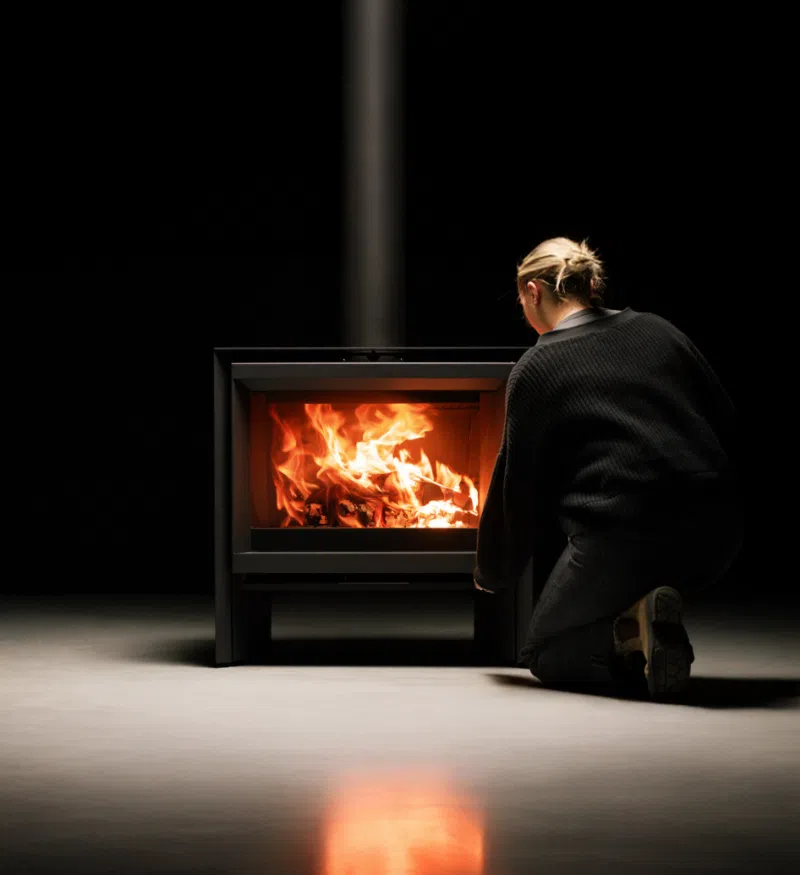
And the legs are not only legs.
The outside air intake is run up through them. That sounds like a footnote; in a modern, well-sealed home it is very nearly the whole thing. A stove that draws its combustion air out of the room is competing with the room — with the building envelope, the range hood, the bathroom fans, every other appliance quietly pulling in the same direction. Taking that air from outside instead is what separates a wood stove that simply works in a tight, well-built house from one that fights it all winter. An optional rear horizontal outlet opens up placements a straight-up-only stove could never take — which matters more than it sounds like it should, once you are standing in a real room with a real ceiling above it.
The numbers, plainly, and with the caveat that matters.
The 6-H is EPA-certified at 21,067 BTU/h, with a nominal output of 44,000 and a maximum of 64,000 — enough to hold roughly 1,400 square feet. It runs at 69% EPA efficiency, emits 1.2 grams per hour of particulate, takes standard 16-inch logs in a 1.6 cubic foot firebox, and is certified UL, ULC, EPA and CSA B415.1-22. The EPA figure and the nominal figure come from different tests measuring different things, and setting them side by side to compare two stoves is how people end up disappointed. We would rather tell you that than let you do it. Ask us which number answers your actual question.
That last certification is not a footnote, and it is worth being exact about why. Metro Vancouver’s Residential Indoor Wood Burning Emission Regulation Bylaw sets a ceiling on what may be registered and burned at all: an appliance has to be certified to CSA B415.1 or the EPA’s 2015 standard, and it has to hold its fine-particulate emissions beneath the ceiling the bylaw prescribes. Since 15 September 2025, an unregistered stove inside the Urban Containment Boundary may not be operated at all. The Stûv 6-H does not merely scrape past that line — it is certified to CSA B415.1-22 and runs at 1.2 grams per hour, comfortably inside what the bylaw permits. A great many handsome wood stoves cannot honestly make that claim, and it is the first thing we check before we let anyone fall in love with one.
The smaller details are where you can feel that this is a Stûv and not a stove-shaped object. The door closes on a double-hook hinge — two points drawing it tight into its frame — because airtightness is the entire game in a modern wood burner. A stove that leaks air is a stove you cannot control, and very nearly everything else on the spec sheet follows from getting that one thing right. The handle is integrated and stays cool to the touch, so there is no brass fussiness hanging off the front of it. It comes in black. Only black. That is not a limitation; it is a decision, and it is the correct one.
A wood fire asks something of you that a gas fire never will. Wood to bring in, ash to carry out, a fire to build and watch and feed. Some people hear that as a cost. Others hear it as the point — the reason to have a fire at all rather than a heater. The 6-H is unmistakably built for the second sort of person, and it has been engineered so that the work it asks of you is the good work, the part you actually wanted, and none of the other kind.
A note on our local rules: the Stûv 6-H is fully certified for installation in Metro Vancouver — UL, ULC, EPA and CSA B415.1-22, at 1.2 g/h of fine particulate — so it is eligible to be registered and burned under Bylaw 1303. Registration itself is the homeowner’s to hold, along with the best-burning-practices declaration that has to be renewed every three years, and individual municipalities can add requirements of their own on top. Beyond the paperwork, a stove is only ever as good as its installation: clearances to combustibles honoured, a hearth pad where the floor calls for one, the chimney lined and run cleanly, and the outside air connected properly through the legs. Those are precisely the parts we work out first, on site and before anything is ordered — measuring, permitting, venting design, registration paperwork, and the installation afterward by our own crew.
A firebox that narrows behind, so the fire can come forward.
Questions people tend to ask
Is the Stûv 6-H legal to install in Metro Vancouver?
Yes. It is certified UL, ULC, EPA and CSA B415.1-22, and it emits 1.2 grams per hour of fine particulate — comfortably inside what Metro Vancouver’s Residential Indoor Wood Burning Emission Regulation Bylaw 1303 permits, rather than scraping past the line. That makes it eligible to be registered and burned. A great many handsome wood stoves cannot honestly make that claim, and it is the first thing we check before anyone falls in love with one.
Does a wood stove have to be registered, and who looks after that?
Since 15 September 2025, an unregistered appliance inside the Urban Containment Boundary may not be operated at all — so registration is not optional paperwork, it is the difference between a stove you can use and one you cannot. The registration is the homeowner’s to hold, along with a best-burning-practices declaration that has to be renewed every three years. We prepare that alongside the permit rather than leaving you to discover it afterward. Individual municipalities can add requirements of their own on top, which is worth checking early.
How large a room will the 6-H heat?
Roughly 1,400 square feet. It is EPA-certified at 21,067 BTU/h, with a nominal output of 44,000 and a maximum of 64,000, running at 69% EPA efficiency with a 1.6 cubic foot firebox. One caution: the EPA figure and the nominal figure come from different tests measuring different things, and setting them side by side to compare two stoves is how people end up disappointed. Ask us which number answers your actual question.
Will a wood stove work properly in a new, well-sealed house?
This one is the reason the 6-H is on the list. Its outside air intake runs up through the legs, so the stove draws its combustion air from outdoors rather than competing with the building envelope, the range hood and every bathroom fan pulling in the same direction. A stove that takes its air from the room will fight a tight modern house all winter. This one does not.
Do I have to keep adjusting the air while it burns?
No. Two metal plates at the base of the combustion chamber expand at different rates as the stove comes up to temperature, and that difference is the mechanism — the stove reads its own heat and adjusts its own air supply continuously, right through the burn. Stûv call it SBR. In a room it means nobody kneels in front of it with a lever, guessing.
Can the flue run out the back rather than straight up?
Yes — an optional rear horizontal outlet is available, and it opens up placements a straight-up-only stove could never take. Which placements are actually available to you depends on the room, the framing and the chimney run, and that is the part we work out on site before anything is ordered.
Does it come in any finish other than black?
It comes in black. Only black. That is not a limitation; it is a decision, and we think it is the correct one.