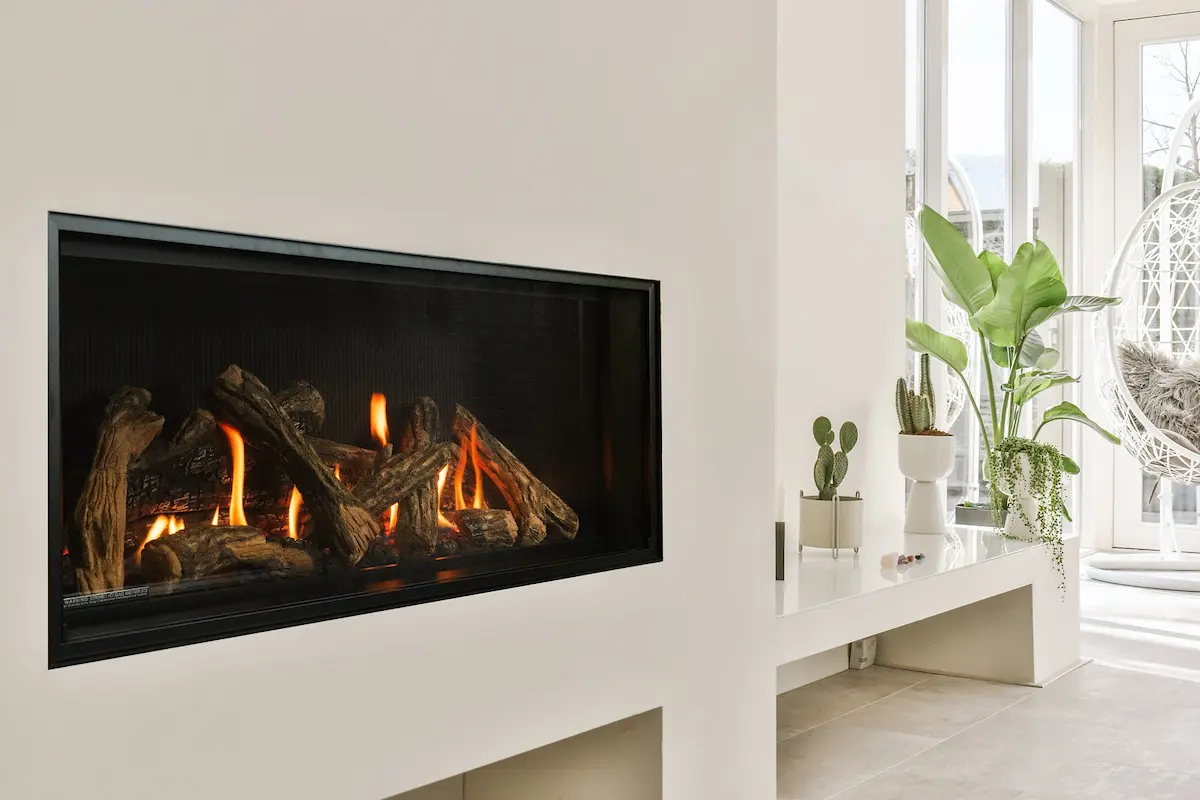
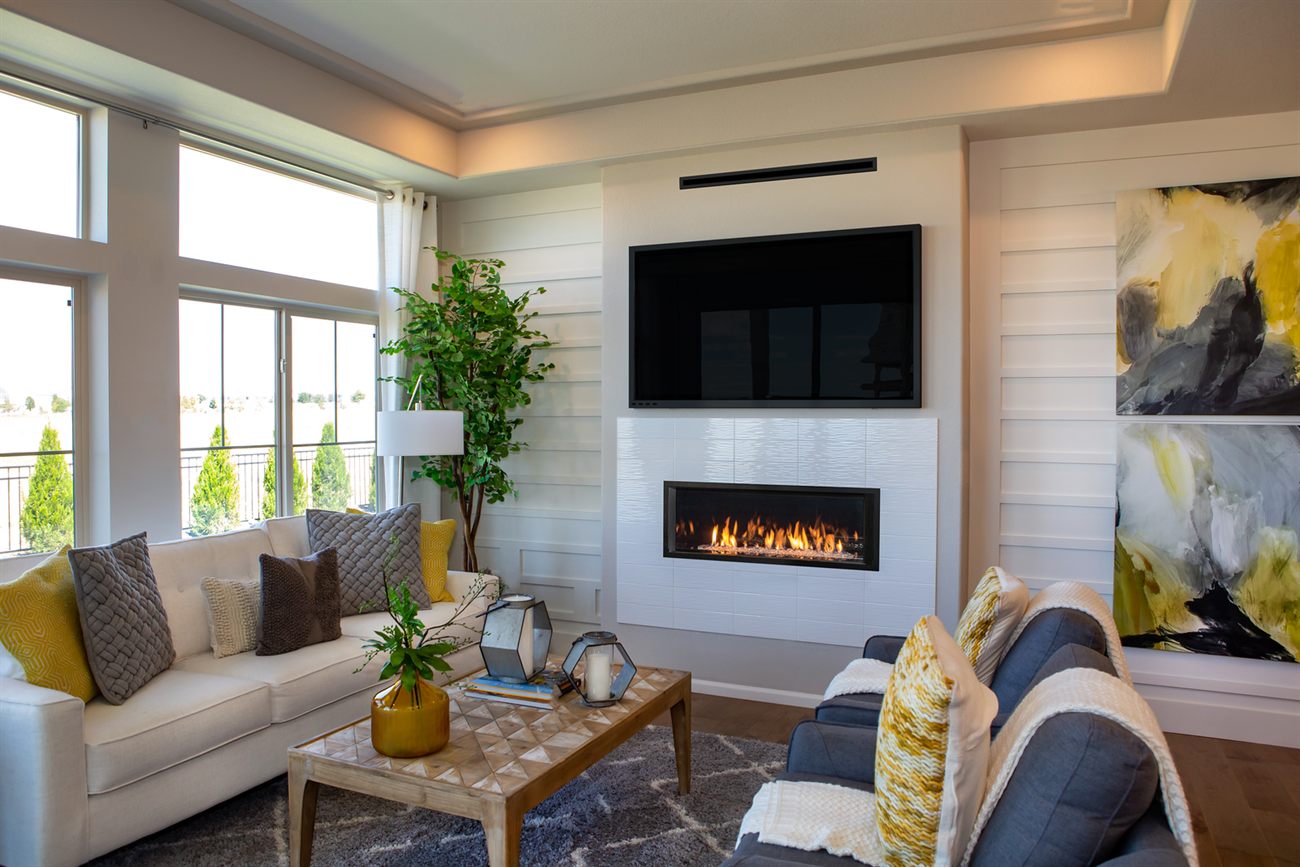
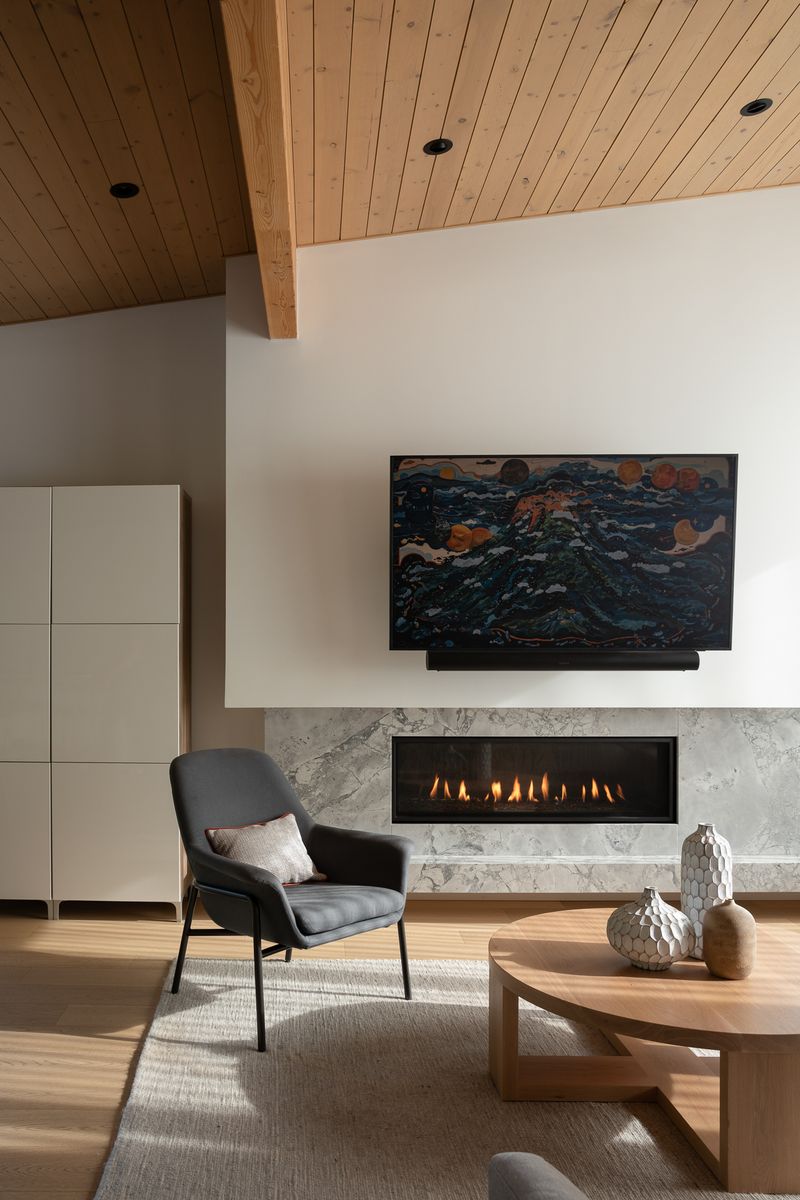
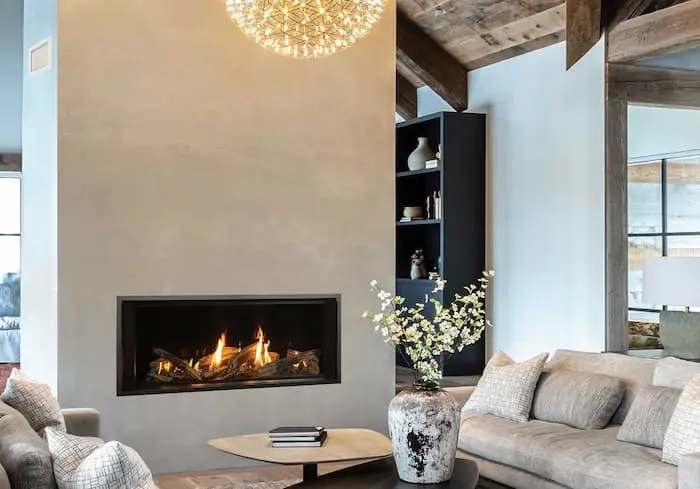
Three widths of low linear fire, two taller Landscape versions, and a family of multi-sided cousins — all radiant, all built to keep warming the room when the power goes out.
The linear fireplace is the shape the modern house asked for. Once walls stopped being interrupted by chimney breasts and started being drawn as long, uninterrupted planes — a run of tile, a slab of stone, a field of plaster — the fire needed a form that belonged in a plane rather than in a box. Low, wide, and glazed edge to edge, it reads less as an appliance than as a line: a horizon of flame set into the wall at the height of a seated eye.
Valor’s answer is the L Series, and it is, characteristically, one idea drawn at several lengths. The L1 is a 40-inch view of the fire; the L2 stretches it to 50; the L3, the largest linear fire Valor makes, runs to 64 inches of glass across a firebox a little over five and a half feet wide. The height stays the same across all three — fourteen and a half inches — and that is the quiet discipline of the range. A linear fire that grows taller as it grows wider turns into a picture window; one that keeps its proportion stays a line, and it is the line that does the work in a room like this.
What separates a Valor from the linear fires it is usually compared with is what you cannot see. Most gas fireplaces of this shape heat a room by fan: air drawn in, blown across the firebox, pushed back out through a grille. A Valor radiates. The heat leaves the glass the way it leaves a south-facing window, as a steady wave you feel on your skin rather than hear in the wall — and because nothing about that asks for a fan or a wall socket, the fire keeps warming the room straight through a power cut. The ignition runs from the batteries in the remote. The night the storm takes the grid is the night you understand the point of it.
Radiant heat brings a problem of its own, and Valor has spent longer solving it than anyone. A wide, hot plane of glass throws a good deal of warmth upward, and the wall above a linear fire is precisely where a household wants to hang a television or a painting. The HeatShift™ system draws the hottest air off the top of the firebox and releases it through a slim vent higher up the wall — in the photograph above, the dark slot over the screen — so the surface directly over the fire stays cool enough to carry electronics, art, or fine plaster right down to the trim. On the L1, L2 and L3 it is an option we recommend on nearly every wall that has anything above it; the optional HeatSplit goes further still, carrying that warmth to another room altogether.
Then Valor did something worth pausing on. It kept the width and raised the fire. The LT1 and LT2 — Valor calls them Landscape fireplaces — take the 40- and 50-inch views of the L1 and L2 and add roughly a third more height, to seventeen and a half inches and nineteen and five-eighths. Those few inches change what the fire can hold. Where the low linear models carry a bed of birch, driftwood or split logs in a single layer, the Landscape versions are built around Valor’s V-Class burner and a set of Grand Traditional logs: a taller, fuller stack with a deep ember glow beneath it, so that a fireplace still drawn as a line begins to look, from the sofa, like a proper wood fire. The LT2, at 932 square inches of glass, is a serious presence on a wall. Both require the HeatShift™ system, which is Valor being honest about how much warmth they make.
An L arrives, as every Valor does, as a set of decisions rather than a fixed object. Five fuel beds — birch, driftwood and split logs, Murano glass, rock and shale — with the Grand Traditional set on the Landscape models. Liners in fluted black, plain black or reflective glass and, on the LT1 and LT2, grey brick. A one-inch Clean Install kit that lets the finish run almost to the glass, or a finishing trim where the wall wants an edge. The Valor 10 remote is standard and will run the fire from a phone if you would rather; a wall switch is in the box. Natural gas or propane, direct vent, co-axial or co-linear, so the flue can leave through the back of the wall or rise through the roof.
And for the open plan that was never laid out around a hearth, the same fire is offered on more than one side: the L1 See-Thru between two rooms, the LX2 as a three-sided or corner fire, and the LX1 as a pier that divides a space without walling it off.
The height stays the same. It is the width that answers the wall.
A linear fire is unforgiving about placement in a way a traditional hearth is not. Its whole effect depends on the line being level, centred on the wall it belongs to, and set at the height a seated person actually looks at; an inch of drift that a mantel would forgive shows plainly in a run of edge-to-edge tile. The vent has to be planned with the framing, the HeatShift™ route with whatever is going above, the finish with the Clean Install kit so the stone or plaster meets the glass the way the drawing promised. That planning is what Maxwell Fireplace does in-house — choosing the length that suits the wall, the fuel bed and liner and front, drawing the vent and HeatShift™ runs before a stud goes up, pulling the permits, installing, and working with the trades who finish the surround so the fire and the wall are drawn as one thing. The LT2 is on display in our showroom now. A linear fire is best judged from a sofa, at the height you will live with it.
Questions people tend to ask
What is the difference between the Valor L Series and the LT Landscape models?
The L1, L2 and L3 are the low linear fires: 40, 50 and 64 inches wide, all 14½ inches tall. The LT1 and LT2 keep the 40- and 50-inch widths and add about a third more height, to 17½ and 19⅝ inches, and are built around Valor’s V-Class burner and the taller Grand Traditional log set, so the fire reads more like a wood fire from across the room. Both Landscape models require the HeatShift™ system.
Does a Valor linear fireplace keep working during a power outage?
Yes. Every model in the family is a radiant heater with no fan, and the ignition runs from the batteries in the remote, so the fire lights and keeps warming the room when the house has no power. That is the single most practical reason to choose a Valor, and the one people are most grateful for later.
Can I hang a television above a Valor L Series fireplace?
Yes, with the HeatShift™ system, which draws the hottest air off the top of the firebox and releases it through a slim vent higher up the wall so the surface directly above the fire stays cool. It is optional on the L1, L2 and L3 and required on the LT1 and LT2. The vent route has to be planned with the framing rather than solved afterward, and that planning is part of what we do.
How much heat does a Valor L Series fireplace produce?
Valor’s published natural-gas inputs are 30,000 BTU for the L1, 36,000 for the L2, 42,000 for the L3, 34,000 for the LT1 and 39,000 for the LT2, and each turns down to somewhere between 18,000 and 23,000 BTU for a mild evening. Matching the size of the fire to the room matters more than the headline figure; an oversized fire in a well-sealed modern house is the most common mistake we are asked to correct.
What fuel beds, liners and fronts can I choose?
Birch, driftwood and split logs, Murano glass, or rock and shale on every model, with the Grand Traditional log set on the LT1 and LT2. Liners in fluted black, plain black or reflective glass, plus grey brick on the Landscape models. Fronts run from a one-inch Clean Install kit that lets the finish meet the glass, to a finishing trim where the wall wants an edge. The Valor 10 remote with app control and a wall switch are included, and every model runs on natural gas or propane.
Where can I see a Valor L Series fireplace in Vancouver?
At Maxwell Fireplace in North Vancouver, where the LT2 is on display and burning. We serve the North Shore, Vancouver and the Sea to Sky corridor, and we are glad to set aside a quiet hour outside of showroom traffic to sit in front of it at the height you would live with it.