The L Series fire, glazed on three sides or wrapped around a corner — a linear fire for the room that was never laid out around a hearth.
A linear fire assumes a wall. It sits in a plane, faces one way, and asks the room to arrange itself in front of it. Most rooms oblige. Some do not: the open plan where the kitchen runs into the sitting room with nothing between them, the pier that carries a beam and not much else, the corner where two windows meet and there is no plane to speak of. For those rooms Valor took the L Series firebox we wrote about earlier and let the glass go round the corner.
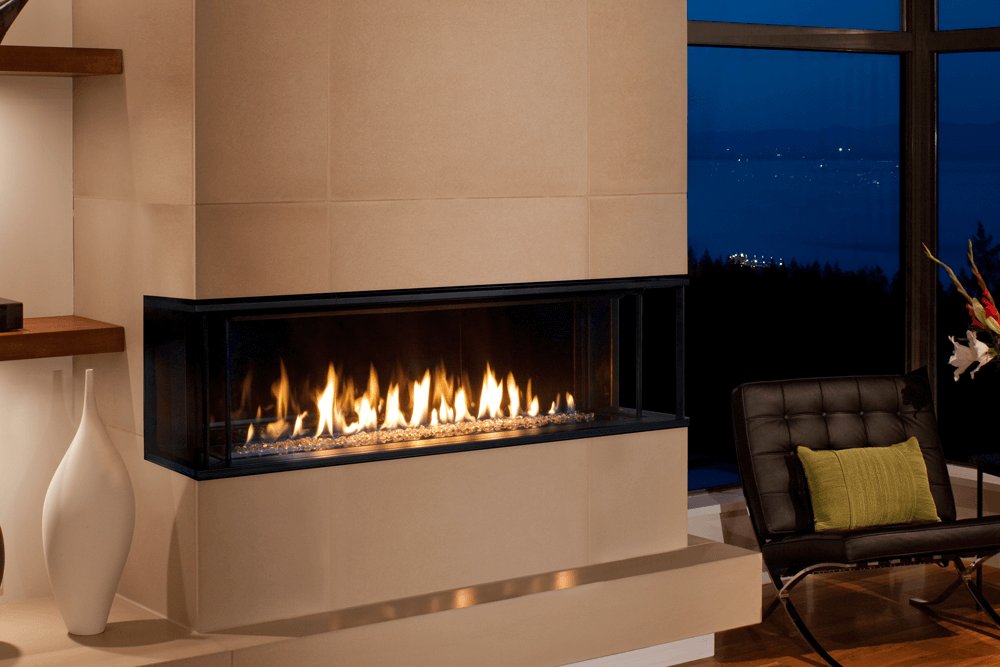
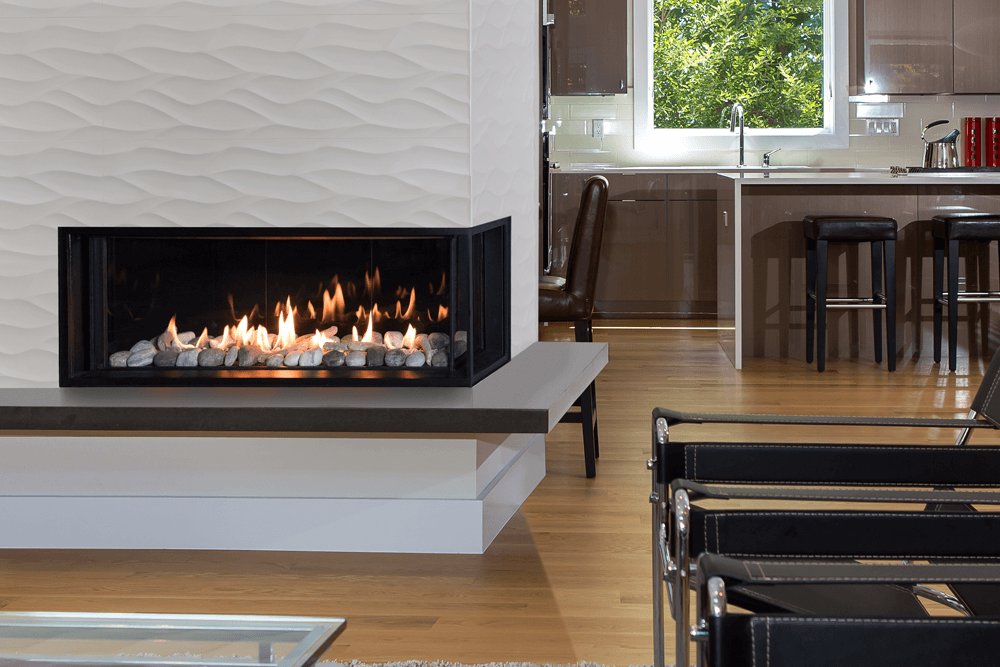
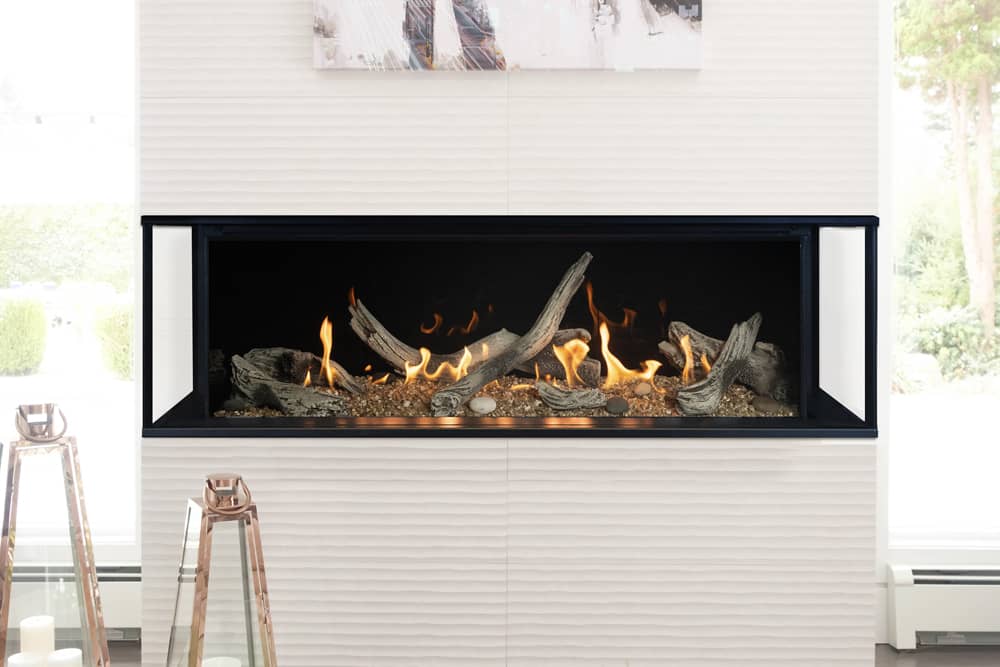
The LX2 is that fire in two engine styles. The three-sided version is glazed on the front and both ends — a hundred and eighty degrees of fire that reads from three directions at once — and it is the model for a pier or a peninsula, a fire set into a spine wall between two spaces that gives both of them the same flame without giving either of them a wall. The corner version, built as a left-hand or a right-hand fire, keeps the front and one end; it takes the corner of a room, or the end of a run of cabinetry, and turns what is usually the dead end of a floor plan into the place people sit.
Because the glass wraps, the fire has to be composed for more than one point of view, and this is what the fuel beds are for. A bed of birch, driftwood or split logs looks like a fire from the front and like sculpture from the end. Murano glass or rock and shale, lit from beneath by a long run of flame, become a low field of light that reads the same from every side. Behind it, a fluted black liner recedes and lets the flame stand alone; reflective glass doubles it. Seen from the kitchen, the same fire is a different fireplace than it is from the sofa, and choosing the bed is choosing which of those two rooms gets the better view.
Everything the L Series is known for comes along unchanged. It is a radiant fire — no fan, no moving air, warmth thrown straight off the glass — and because the ignition runs from the batteries in the remote, it lights and keeps heating the room when the power is out. The Valor 10 remote is standard and will run the fire from a phone; a wall switch is in the box. Natural gas or propane, with up to 36,000 BTU on the top setting and a low burn of 19,000 for a mild evening.
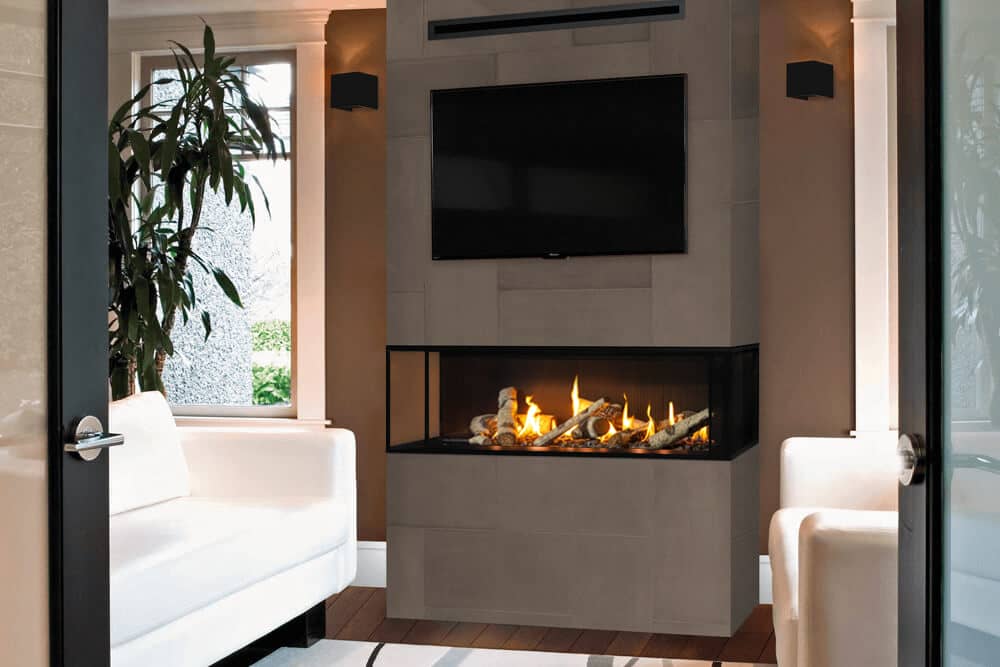
What is different is that the HeatShift™ system is not optional here. Three panes of glass make a great deal of warmth, and Valor is honest about it: the LX2 is sold with the system that draws the hottest air off the top of the firebox and releases it higher up the pier, so the wall — and the television that so often ends up on it — stays cool. In the photograph at the top of this page, the slim dark slot above the screen is where that warmth leaves.
A fire that turns the corner changes where the room begins.
A multi-sided fire is the most demanding thing we install, and the most rewarding. A single-face fire forgives an inch; a fire glazed on three sides is squared to the room from every direction at once, and the pier it sits in is usually structural, usually carrying a beam, and usually finished in stone or tile that was chosen before anyone measured a firebox. The vent, the HeatShift™ route, the gas line and the framing have to be drawn together, and early. That is the work Maxwell Fireplace does in-house — helping you decide between three sides and a corner, and between a left-hand and a right-hand fire; choosing the bed and the liner for the views that matter; planning the vent and HeatShift™ runs with the framer before a stud goes up; pulling the permits; installing; and working with the trades who finish the pier so the fire and the stone are drawn as one thing. It is the fire we most enjoy seeing finished.
Questions people tend to ask
What is the difference between the LX2 three-sided and the LX2 corner?
They share the same firebox, fuel beds and liners; the difference is where the glass is. The three-sided version is glazed on the front and both ends, a full 180 degrees of fire, and is the one for a pier, a peninsula or a spine wall between two rooms. The corner version keeps the front and one end, and is built as a left-hand or a right-hand fire, so it can take the corner of a room or the end of a run of cabinetry.
Is the LX2 the same fire as the Valor L Series?
It is the multi-sided member of the family. The LX2 runs at the same 36,000 BTU maximum input on natural gas as the L2, turns down to 19,000 BTU, and takes the same birch, driftwood and split-log beds, Murano glass and rock and shale. What changes is that the glass wraps around two or three sides, which is why the fuel bed is chosen with more than one point of view in mind.
Does the Valor LX2 need the HeatShift system?
Yes. Unlike the L1, L2 and L3, where HeatShift™ is optional, the LX2 requires it. Two or three panes of glass make a great deal of radiant warmth, and the system draws the hottest air off the top of the firebox and releases it higher up the pier so the surface above the fire, and the television that so often ends up there, stays cool. The route has to be planned with the framing, which is part of what we do.
Does the LX2 work during a power outage?
Yes. It is a radiant heater with no fan, and the ignition runs from the batteries in the remote, so it lights and keeps warming the room when the house has no power.
Which fuel beds and liners can I choose for the LX2?
Birch, driftwood or split logs, Murano glass, or rock and shale for the bed, and a fluted black or reflective glass liner behind it. For a fire seen from more than one side, a glass or stone bed reads the same from every angle, while a log set looks like a fire from the front and like sculpture from the end. The Valor 10 remote with app control and a wall switch are included, and the fire runs on natural gas or propane.
Where can I see a Valor LX2 in Vancouver?
Come to Maxwell Fireplace in North Vancouver. The Valor L Series is part of our showroom, and we are glad to set aside a quiet hour to walk through the three-sided and corner configurations and the fuel beds that suit each. We serve the North Shore, Vancouver and the Sea to Sky corridor.